
Cricket · Level 1: Beginner · Sub-level 1.3
The Ground and the Kit
5 tests · 50 facts · updated 6 September 2026 · markdown
This sub-level teaches the shape of a cricket ground and its boundary; the 22-yard pitch and the crease lines drawn on it; the wicket of three stumps and two bails and what it means to break it; the ball, its seam and its colours; and the bat and the protective kit, including why the wicket-keeper alone wears gloves and pads.
Each test below is ten questions on Insporta. The list under a test is what the questions check: one fact per question, with the source it was written from. Read it before the test, or come back from a wrong answer.
Test 1The field and the boundary
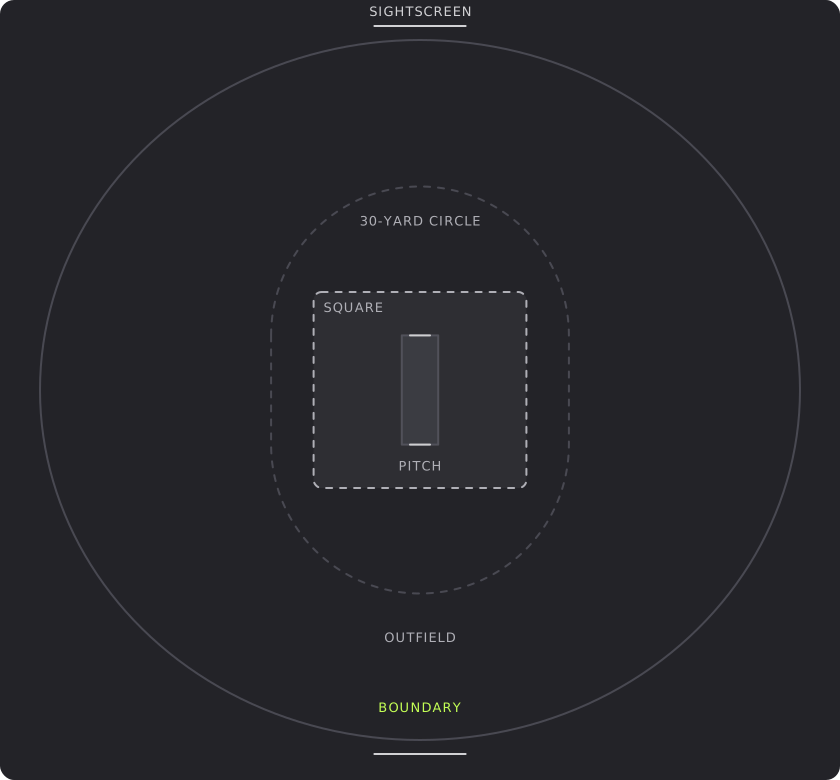
Grounds are broadly oval, and neither the shape nor the size of the outfield is laid down by the Laws.
Source: General playing principle · recall
The boundary is the perimeter of the field, usually a rope; a ball crossing it scores four or six.
Source: MCC Laws of Cricket 2017 code (3rd edition 2022), Law 19 · recall
Boundary length varies from ground to ground, and even around one ground; there is no standard measurement.
Source: MCC Laws of Cricket 2017 code (3rd edition 2022), Law 19 · applied
The square is the central block of prepared surfaces; a different strip on it is used for different matches.
Source: General cricket terminology · recall
The outfield is everything between the central square and the boundary rope.
Source: General cricket terminology · recall
The sightscreen gives a plain background behind the bowler so the batter can pick up the ball on release.
Source: General playing conditions · applied
Most grounds are longer straight and shorter square, so the boundary is not a uniform distance.
Source: General playing conditions · recall
The Laws require the boundary to be agreed and marked; its distance and the ground's shape are not prescribed.
Source: MCC Laws of Cricket 2017 code (3rd edition 2022), Law 19 · applied
The inner circle sets how many fielders may stand outside it during the powerplay and later phases.
Source: ICC Playing Conditions (fielding restrictions) · recall
A quick outfield speeds the ball along the ground, so more well-timed shots reach the rope.
Source: General playing principle · applied
Test 2The pitch and the creases
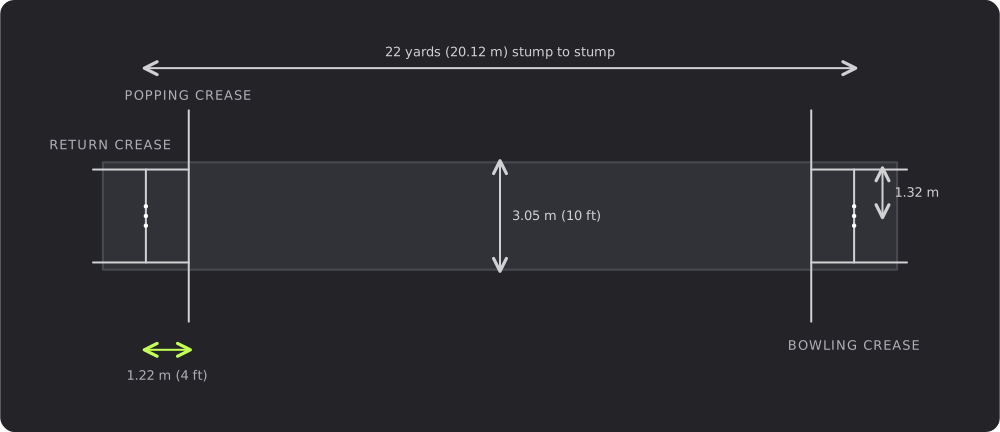
The pitch is the 22-yard playing strip; the square is the wider area from which such strips are cut.
Source: MCC Laws of Cricket 2017 code (3rd edition 2022), Law 6 · recall
The pitch is a fixed 22 yards from stump to stump, which is one chain, an old unit of length.
Source: MCC Laws of Cricket 2017 code (3rd edition 2022), Law 6 · recall
The popping crease runs across the pitch four feet in front of the stumps and is used by batters and bowlers alike.
Source: MCC Laws of Cricket 2017 code (3rd edition 2022), Law 7 · recall
The return creases mark the outer limits within which the bowler's back foot must land on delivery.
Source: MCC Laws of Cricket 2017 code (3rd edition 2022), Law 7 · recall
The crease line itself is not part of the batter's ground; bat or body must be grounded behind it.
Source: MCC Laws of Cricket 2017 code (3rd edition 2022), Law 30 · applied
A pitch is not changed during a match, so it deteriorates: cracks open, the bounce varies and spinners get more help.
Source: MCC Laws of Cricket 2017 code (3rd edition 2022), Law 6 · applied
Bowlers running through on their follow-through scuff the pitch, and spinners later aim the ball into that rough.
Source: General playing principle · applied
Grass and moisture help seam movement and carry, so a green pitch usually favours the quicker bowlers first.
Source: General playing principle · recall
A worn, dry surface grips and turns the ball, so spin bowling becomes the main threat late in a long match.
Source: General playing principle · applied
Running on the protected area is unfair to the batting side; after warnings the bowler is taken out of the attack.
Source: MCC Laws of Cricket 2017 code (3rd edition 2022), Law 41 · applied
Test 3The wicket
A wicket is three wooden stumps of equal size with two small bails sitting in grooves across the top.
Source: MCC Laws of Cricket 2017 code (3rd edition 2022), Law 8 · recall
Removing at least one bail from the top of the stumps is enough for the wicket to count as broken.
Source: MCC Laws of Cricket 2017 code (3rd edition 2022), Law 29 · recall
With no bail dislodged the wicket is not broken, so there is no dismissal, however hard the stumps were struck.
Source: MCC Laws of Cricket 2017 code (3rd edition 2022), Law 29 · applied
With no bails on, the wicket can only be broken by removing a stump from the ground.
Source: MCC Laws of Cricket 2017 code (3rd edition 2022), Law 29 · applied
Loose bails come off at a touch, which is how the umpire can tell the wicket has been broken.
Source: MCC Laws of Cricket 2017 code (3rd edition 2022), Law 8 · recall
If the wind keeps blowing the bails off, the umpires can do without them and judge the wicket by the stumps alone.
Source: MCC Laws of Cricket 2017 code (3rd edition 2022), Law 8 · recall
The bail must be completely removed; one that pops up and lands back on has not broken the wicket.
Source: MCC Laws of Cricket 2017 code (3rd edition 2022), Law 29 · applied
The stumps stand close together so a ball cannot slip through, and the wicket is the same size at both ends.
Source: MCC Laws of Cricket 2017 code (3rd edition 2022), Law 8 · recall
Pulling a stump out of the ground with the ball in hand breaks the wicket, just as removing a bail does.
Source: MCC Laws of Cricket 2017 code (3rd edition 2022), Law 29 · applied
"Wicket" names the stumps, but "a slow wicket" or "a green wicket" refers to the pitch itself.
Source: General cricket terminology · applied
Test 4The ball
The ball is a cork-and-string core inside a leather cover, with a raised stitched seam around the middle.
Source: MCC Laws of Cricket 2017 code (3rd edition 2022), Law 4 · recall
The seam is the stitched join; landing on it can move the ball off the pitch, and its angle affects swing in the air.
Source: MCC Laws of Cricket 2017 code (3rd edition 2022), Law 4 · recall
Red balls are used for first-class and Test cricket played in daylight, showing up well against the players' whites.
Source: MCC Laws of Cricket 2017 code (3rd edition 2022), Law 4 · recall
White balls are used in limited-overs cricket, where players wear coloured clothing and games often run into the evening.
Source: ICC Playing Conditions (white-ball cricket) · recall
The pink ball was brought in for day-night Tests because it shows up under lights better than red and lasts longer than white.
Source: ICC Men's Test Match Playing Conditions · applied
An old, soft ball does less for the quicks, so captains often use spin until a new ball becomes due.
Source: General playing principle · applied
A shiny side against a rougher side helps the ball swing; sides may polish it with sweat within the Laws' limits.
Source: General playing principle · applied
The Laws fix a narrow weight range for a men's ball; women's and junior balls are lighter.
Source: MCC Laws of Cricket 2017 code (3rd edition 2022), Law 4 · recall
A ball that loses its shape, or is lost, is replaced by one the umpires judge to be at a comparable state of wear.
Source: MCC Laws of Cricket 2017 code (3rd edition 2022), Law 4 · applied
In Tests a new ball is available after 80 overs, and taking it can restore pace, bounce and swing.
Source: ICC Men's Test Match Playing Conditions · recall
Test 5The bat and the protective kit
The Laws require the blade to be wood; an aluminium bat was tried in 1979 and quickly outlawed.
Source: MCC Laws of Cricket 2017 code (3rd edition 2022), Law 5 · recall
A bat may be no longer than 38 inches and no wider than 4.25 inches, with limits on edge and depth added in 2017.
Source: MCC Laws of Cricket 2017 code (3rd edition 2022), Law 5 · recall
A bat outside the permitted dimensions may not be used; the batter has to change it for a legal one.
Source: MCC Laws of Cricket 2017 code (3rd edition 2022), Law 5 · applied
Batting pads guard the front of the legs against a ball that can be bowled at 140 km/h or more.
Source: General playing equipment · recall
A helmet with a grille guards the head and face; helmets became standard after serious injuries from the 1970s on.
Source: General playing equipment · recall
The "box" is an abdominal protector; "taking guard" is a different thing entirely, done with the bat.
Source: General playing equipment · recall
Only the nominated wicket-keeper may wear keeping gloves and pads; every other fielder catches with bare hands.
Source: MCC Laws of Cricket 2017 code (3rd edition 2022), Law 27 · recall
Keeping gloves are for the wicket-keeper alone; any other fielder must field with bare hands.
Source: MCC Laws of Cricket 2017 code (3rd edition 2022), Law 27 · applied
A hard ball can injure, so a batter should wear a helmet, leg pads, batting gloves and an abdominal protector.
Source: General playing safety · applied
Keeping gloves have a webbed pocket for catching; batting gloves are padded on the back to protect the fingers.
Source: MCC Laws of Cricket 2017 code (3rd edition 2022), Law 27 · recall
Sources
MCC Laws of Cricket 2017 code (3rd edition 2022) for the mechanics of play; ICC Playing Conditions for international format and officiating detail, which override the Laws where they differ; ESPNcricinfo and Wisden for history, records and governance. Questions are authored from these sources, not reproduced from them.
- General playing principle7
- MCC Laws of Cricket 2017 code (3rd edition 2022), Law 295
- MCC Laws of Cricket 2017 code (3rd edition 2022), Law 45
- MCC Laws of Cricket 2017 code (3rd edition 2022), Law 84
- MCC Laws of Cricket 2017 code (3rd edition 2022), Law 193
- General cricket terminology3
- MCC Laws of Cricket 2017 code (3rd edition 2022), Law 63
- MCC Laws of Cricket 2017 code (3rd edition 2022), Law 53
- General playing equipment3
- MCC Laws of Cricket 2017 code (3rd edition 2022), Law 273
- General playing conditions2
- MCC Laws of Cricket 2017 code (3rd edition 2022), Law 72
- ICC Men's Test Match Playing Conditions2
- ICC Playing Conditions (fielding restrictions)1
- MCC Laws of Cricket 2017 code (3rd edition 2022), Law 301
- MCC Laws of Cricket 2017 code (3rd edition 2022), Law 411
- ICC Playing Conditions (white-ball cricket)1
- General playing safety1