
Triathlon · Level 3: Pre-Intermediate · Sub-level 3.5
Peaking, Recovery and Injury
10 tests · 100 facts · updated 6 September 2026 · markdown
Arriving fresh and staying in the sport: taper science, race week, recovering from a race, the injuries triathletes actually get, returning to training, training around illness, the off-season, and building a year and a career rather than a single block.
Each test below is ten questions on Insporta. The list under a test is what the questions check: one fact per question, with the source it was written from. Read it before the test, or come back from a wrong answer.
Test 1Taper Science
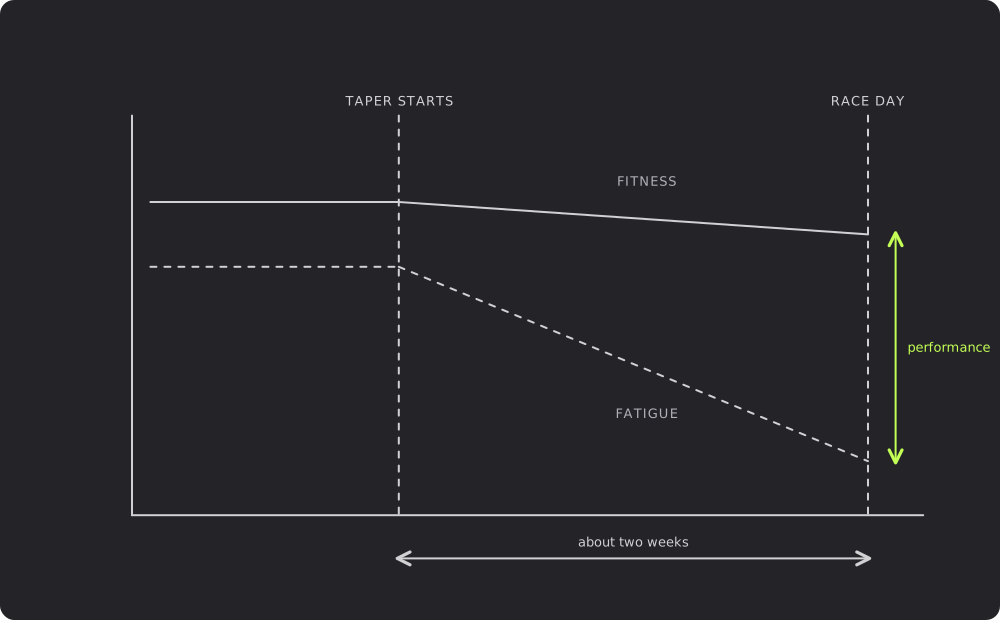
Fitness and fatigue both fall when training is reduced, but fatigue falls faster, which is what unmasks performance. Some genuine positive changes do occur during a taper, blood volume and muscle glycogen among them, but the dominant effect is fatigue clearing first.
Source: Endurance coaching and sports medicine reference
Reducing volume is the change that removes fatigue, and it is the strongest moderator of taper outcome in the literature. Intensity and frequency are what protect the fitness while it happens.
Source: Endurance coaching and sports medicine reference
Studies that cut intensity along with volume lose much of the taper effect, so intensity is the part that is held. Sharpness is the first thing to go when every session becomes easy.
Source: Endurance coaching and sports medicine reference
Taper research generally favours keeping most sessions and shortening them rather than removing whole sessions. Swimming in particular loses feel for the water fast when frequency drops.
Source: Endurance coaching and sports medicine reference
Around two weeks is the best-supported average, but the spread across individuals is wide and optimal taper length remains an open question. Treat published figures as a starting point, not a prescription.
Source: Endurance coaching and sports medicine reference
Progressive, exponential-style reductions edge out step tapers in the literature, though the difference is modest. How much volume comes out still matters more than the exact curve.
Source: Endurance coaching and sports medicine reference
The sensation is familiar to almost every experienced athlete but has little research behind it in either direction. The practical response is to expect it and not to redesign the taper around it.
Source: Endurance coaching and sports medicine reference
Reduced training beats no training in taper studies, because stopping removes the intensity and frequency that hold sharpness. The point is less training, not absent training.
Source: Endurance coaching and sports medicine reference
The fitness and fatigue clocks run at different speeds: the cost lands within hours, any benefit weeks later. A late session can only spend the taper, never add to it.
Source: Endurance coaching and sports medicine reference
Accumulated fatigue, training history, age and the race itself all shift the answer, and no published average resolves it for you. Lower-priority races are the safe place to experiment.
Source: Endurance coaching and sports medicine reference
Test 2Race Week
Sleep debt built over days is what degrades endurance performance, whereas a single broken pre-race night is tolerated surprisingly well. Protecting the earlier nights takes the pressure off the last one.
Source: Endurance coaching and sports medicine reference
A day per time zone is a rule of thumb rather than a law, but it sets realistic expectations for arrival timing. Light exposure at the right hours is the strongest tool available to an age-grouper.
Source: Endurance coaching and sports medicine reference
What changes in race week is the exposure, not your resistance, and the cost of catching something is at its highest. Sustained vitamin C over weeks has some support specifically in athletes under heavy exertion; starting a dose in race week does not.
Source: Endurance coaching and sports medicine reference
The session exists to keep the neuromuscular sharpness the taper is protecting, not to measure fitness. Anything leaving residual fatigue has taken more than it gave.
Source: Endurance coaching and sports medicine reference
Glycogen stores are filled by a sustained high intake over a day or two, not by a single meal, and falling volume is exactly why intake must not follow it down. These are guidance ranges, not prescriptions.
Source: ACSM/AND/DC and IOC nutrition position statements
Water stored alongside glycogen is part of the point, since it arrives with the fuel you will use. Cutting intake to chase the number on the scale undoes the loading you just did.
Source: ACSM/AND/DC and IOC nutrition position statements
The asymmetry is the whole argument: an untested change might gain you seconds and might cost you the race. That logic covers anything entering the body or altering the bike, not only kit.
Source: Endurance coaching and sports medicine reference
Deciding things in advance means fewer decisions under pressure, and reappraising arousal as readiness has reasonable experimental support. The arousal itself is not the problem.
Source: Sport psychology and endurance coaching reference
The adaptations that take weeks or months are already fixed by race week, so chasing them is wasted effort. What remains changeable deserves real attention.
Source: Endurance coaching and sports medicine reference
The taper reduces training load, not total load, and a race destination is full of unplanned time on your feet. Plan sitting down as deliberately as you plan the sessions.
Source: Endurance coaching and sports medicine reference
Test 3Post-Race Recovery
Recovery is several overlapping processes running at different speeds, not one clock. The fast ones finish first, which is why athletes feel ready before their tissues are.
Source: Endurance coaching and sports medicine reference
It is the accumulation, not any single system, that stretches the timeline. The race sits on top of a long build, so what is recovering is the whole campaign as well as the day.
Source: Endurance coaching and sports medicine reference
Post-race soreness comes from eccentric muscle damage, not lingering lactate, which clears within about an hour. Choose whichever option returns you to normal life more comfortably.
Source: Endurance coaching and sports medicine reference
Gentle movement is generally comfortable within a few days and is guided by symptoms rather than by a date. Pain in one specific spot is a different question from general soreness and needs assessment.
Source: Endurance coaching and sports medicine reference
Soreness clears long before the deeper fatigue does, so it is a poor gate for intensity. Several markers returning to normal together is a far better signal than any one of them.
Source: Endurance coaching and sports medicine reference
This is an active scientific dispute rather than a fact to be memorised in either direction. The sensible habits after a hard race hold up whichever way the debate resolves.
Source: Exercise immunology literature and sports medicine reference
Sleep, food and hygiene are the measures with genuine support, and none of them depend on the disputed theory. Systemic symptoms mean stop and get advice, not push on.
Source: Endurance coaching and sports medicine reference
Cold-water immersion is genuinely contested, and its clearest effect is on how sore you feel. The usual objection concerns blunting adaptation, which matters far less once the goal race is behind you.
Source: Endurance coaching and sports medicine reference
Losing months of structure and purpose overnight, on top of real physical fatigue, explains it in most athletes. Persistence is what turns it from expected into something for a clinician.
Source: Endurance coaching and sports medicine reference
Cola-coloured urine with reduced output needs emergency assessment the same day, because kidney injury is time-dependent; chest pain or breathlessness means emergency services, not monitoring at home. Rapidly drinking a large volume of water after a race is itself risky, since that is how exercise-associated hyponatraemia develops.
Source: Sports medicine and emergency care reference
Test 4Common Triathlon Injuries
Running's repeated impact loading carries a musculoskeletal cost the other two disciplines do not, so it dominates the injury picture. Hours trained are a poor guide to where injuries appear.
Source: Sports medicine and triathlon injury epidemiology reference
The question that matters is what a given tissue has been prepared for, not what the weekly hours look like in a spreadsheet. Tissue capacity is trainable, but it climbs more slowly than aerobic fitness.
Source: Sports medicine and triathlon injury epidemiology reference
Being able to keep training is an advantage that quietly removes the usual prompt to get something looked at. A niggle that persists should be assessed even though you can still train around it.
Source: Sports medicine and triathlon injury epidemiology reference
Several different structures can produce the same presentation, which is exactly why the label does not tell you what is wrong. Identifying the actual problem is a job for a qualified clinician.
Source: Sports medicine and triathlon injury epidemiology reference
Single-cause accounts of overuse injury are widely disputed, and the same presentation can arise from several contributors at once. Reviewing the plausible factors is useful; pain that persists still needs a clinician.
Source: Sports medicine and triathlon injury epidemiology reference
Tolerance for a held position is trained in increments like anything else, and a sudden change is a load spike. Pain that does not settle as exposure is rebuilt needs assessment.
Source: Sports medicine and triathlon injury epidemiology reference
The trend across weeks is more informative than how any single session felt. A worsening trend is a reason to be assessed by a clinician rather than to keep self-managing.
Source: Sports medicine and triathlon injury epidemiology reference
The 24-hour symptom-response rule is validated for tendon and soft tissue and does not apply to bone. Focal bone pain needs qualified assessment regardless of how it feels the next day.
Source: Sports medicine and bone stress injury reference
Risk can be reduced substantially but never removed. This concerns musculoskeletal screening batteries, not medical or cardiac clearance, which is a separate question with separate guidance.
Source: Lauersen et al., BJSM 2014 meta-analysis; sports medicine reference
These features separate something needing examination from ordinary training soreness. Nothing in this course, or online, can diagnose an injury; that requires a clinician who can examine you.
Source: Sports medicine and triathlon injury epidemiology reference
Test 5Returning to Training After Injury
A layoff lowers the tissue's load tolerance at the same time as it settles symptoms, so a binary rest-then-resume return puts the old load onto a weaker tissue. A graded rebuild raises capacity back towards the load rather than assuming it survived the break.
Source: Sports medicine and endurance coaching reference
In a graded return the useful signal is the trend across sessions, not whether a single run was comfortable. This rule applies to an injury a clinician has identified as soft tissue: deciding for yourself that pain is soft-tissue rather than bone is not something an athlete can do reliably.
Source: Sports medicine and endurance coaching reference
The symptom-response reasoning used for tendon and soft tissue does not hold for bone stress injury, whose early presentation can pass that test while the lesion progresses. Focal bone pain is a reason for assessment, not for a bigger step.
Source: Sports medicine and endurance coaching reference
Cross-training exists to keep the aerobic system working without provoking the injury, so the choice follows the tissue: aqua-jogging or swimming may suit a lower-limb bone injury that cycling would still aggravate, and vice versa.
Source: Sports medicine and endurance coaching reference
What transfers between the disciplines is mainly the central cardiovascular base; the musculoskeletal tolerance for repeated impact is built by running alone. This mismatch is the classic trap that turns a good layoff into a re-injury.
Source: Sports medicine and endurance coaching reference
Criteria such as completing the current step with an acceptable response, or regaining strength on the injured side, describe readiness; a week number only describes the passage of time.
Source: Sports medicine and endurance coaching reference
Re-injury usually reflects the steepness of the return rather than a failure of healing. Capacity rebuilds more slowly than the athlete's sense of readiness improves, so an aggressive ramp reproduces the original overload.
Source: Sports medicine and endurance coaching reference
If distance, pace and terrain all move in the same week, a flare cannot be traced to any of them. Changing one thing per step keeps the symptom response readable and keeps the highest-stress load, intensity, until last.
Source: Sports medicine and endurance coaching reference
Symptom resolution and capacity restoration run on different timescales, with pain typically clearing first. Stopping rehab at the point pain disappears leaves the tendon short of the tolerance it needs.
Source: Sports medicine and endurance coaching reference
A flare is information about step size, not a reason to restart the whole process or to push harder. Returning to the last tolerated level preserves the progress already made.
Source: Sports medicine and endurance coaching reference
Test 6Illness and Training
The neck check is a widely taught rule of thumb, not a medical rule; it was never designed to diagnose anything or to grant permission. Any real uncertainty about an illness belongs with a doctor.
Source: Sports medicine and endurance coaching reference
The heuristic breaks down exactly here: an illness can be systemic from the start while the most obvious symptom sits above the neck. Mixed pictures should be treated as the more serious of the two, and a doctor decides the rest.
Source: Sports medicine and endurance coaching reference
Fever means stop training completely, and see a doctor if it is high or persistent. It is one of the clearest markers that the illness is systemic rather than a local nuisance.
Source: Sports medicine and endurance coaching reference
Myocarditis is uncommon but serious, and it is one reason why below-the-neck symptoms during an infection are treated as a stop signal rather than a judgement call. Only a doctor can assess it.
Source: Sports medicine and endurance coaching reference
Chest pain, chest tightness, palpitations, fainting or breathlessness out of proportion to the effort are stop-now symptoms. No athlete can exclude a cardiac cause on their own, and after an infection the possibility is real, so training stops until you are cleared.
Source: Sports medicine and endurance coaching reference
Because the error is directional rather than random, athletes need an external rule and, when symptoms are systemic, a doctor. 'I feel fine enough' is the least reliable input available.
Source: Sports medicine and endurance coaching reference
Capacity and immune function lag behind symptom resolution, so the fortnight after an illness is where athletes most often relapse or dig a deeper hole. A slower return costs very little.
Source: Sports medicine and endurance coaching reference
Plasma volume and a few per cent of VO2max fall within days to weeks, and strength holds far longer, so the cost of a short break is small and quickly recovered. The downside risk of training through is not.
Source: Sports medicine and endurance coaching reference
An infectious athlete at a group session can put several people's training weeks at risk. Infectious periods do not end simply because a day has passed or because the session happens to be in a pool.
Source: Sports medicine and endurance coaching reference
A cardiovascular response clearly out of proportion to the effort after an infection is one of the situations a doctor needs to see. It may be nothing, but that is not a call the athlete can make.
Source: Sports medicine and endurance coaching reference
Test 7The Off-Season
A season leaves residual fatigue that weekly recovery does not fully clear. The off-season exists to reset that baseline, which is what makes the following build productive.
Source: Sports medicine and endurance coaching reference
Most athletes need only a short period of true rest, followed by weeks of low-pressure, enjoyable activity. The defining feature of the latter is the absence of structure and targets, not the absence of movement.
Source: Sports medicine and endurance coaching reference
Detraining is not uniform: cardiovascular measures fall within days to weeks, while strength and the structural base hold on far longer. That asymmetry is why a short break is cheap and a long one is not.
Source: Sports medicine and endurance coaching reference
An athlete coming off a long season with several key races needs more than one who raced twice. The length is set by the fatigue to be cleared, not by a number on a template.
Source: Sports medicine and endurance coaching reference
In season, lifting is squeezed to whatever will not compromise key sessions. With those sessions gone, the interference problem largely disappears and a genuine strength block becomes possible.
Source: Sports medicine and endurance coaching reference
Rewiring a movement pattern costs performance in the short term and needs many low-pressure repetitions. Attempting it inside a race build usually means abandoning it the first time a session goes badly.
Source: Sports medicine and endurance coaching reference
Rehab needs weeks of consistent loading and some tolerance for disruption, which a race build cannot offer. Carrying an unresolved niggle into the next season is how it becomes the next injury.
Source: Sports medicine and endurance coaching reference
The cost is not visible within any one season, which is why the pattern persists. It shows up as a multi-year plateau, a rising injury count, or a loss of appetite for training.
Source: Sports medicine and endurance coaching reference
Motivation is a finite resource that a long season depletes alongside physical freshness. An athlete who starts a build already wanting to train will complete far more of it.
Source: Sports medicine and endurance coaching reference
Turning the off-season into a secret build defeats its purpose and carries the season's fatigue forward. Reduced hours, variety and an accepted dip in fitness are all features of it working correctly.
Source: Sports medicine and endurance coaching reference
Test 8Building the Training Year
The qualities that take longest to build are exactly the ones a short plan cannot create. The annual plan is the container that gives them time.
Source: Endurance coaching reference
The year is a loop, not a ramp: it ends in a deliberate break that sets up the next one. The phases differ in what they emphasise, not only in how much work they contain.
Source: Endurance coaching reference
Base is aerobically weighted, not intensity-free. A touch of hard work maintains qualities that are expensive to rebuild from nothing.
Source: Endurance coaching reference
The break is a repair window for tissue and motivation alike. Losing a little fitness is the price, and it is cheap relative to arriving at the next season already worn down.
Source: Endurance coaching reference
Sharp form is not something you hold for months, so the year is split into two smaller cycles. The second build is shorter because it starts from a much higher platform.
Source: Endurance coaching reference
Counting backwards turns a vague hope into a dated schedule that either fits or does not. Discovering it does not fit is the point, not a failure of the method.
Source: Endurance coaching reference
Periodisation is a useful way to organise a year and to make sure nothing is forgotten. That is a weaker claim than saying it is the proven best way, and the weaker claim is the honest one.
Source: Endurance coaching reference
A technique change costs speed before it pays it back, and heavy lifting leaves legs that race badly. Both need a stretch of calendar where that does not matter.
Source: Endurance coaching reference
You cannot race well and carry the biggest weeks of the year at the same time. The volume peak belongs earlier; the racing phase trades it for freshness.
Source: Endurance coaching reference
Illness, work and weather will all rewrite the plan. A year plan should be firm about phases and goals and loose about individual sessions.
Source: Endurance coaching reference
Test 9Progressing Across Seasons
The fast adaptations arrive within a block; the slow ones stack season on season. Ability to handle a bigger load is itself one of the things that grows.
Source: Endurance coaching reference
Maximal oxygen uptake responds most in the untrained and then plateaus, while the skills and the tolerance to training keep developing. That is where later-career progress usually comes from.
Source: Endurance coaching reference
An October ride and a June ride differ in phase, fatigue and weather as well as fitness. Comparing like with like a year apart strips out most of that, though not all of it.
Source: Endurance coaching reference
A training plan is a prescription for a particular athlete at a particular moment. The athlete moved on and the plan did not.
Source: Endurance coaching reference
Extra hours poured onto an unaddressed weakness buy very little, and there is a ceiling on hours anyway. Changing the distribution, the emphasis or the target of the work is often the cheaper lever.
Source: Endurance coaching reference
The shape of the curve is well recognised; the numbers on its axis are not. Treat any quoted annual percentage as a rough illustration rather than a target.
Source: Endurance coaching reference
Progress does not stop, it narrows. Finding the one thing that is holding a race together badly is usually worth more than another general increase in training.
Source: Endurance coaching reference
The A-race result is one data point produced by a year of inputs. The records of that year are what tell you which input to change.
Source: Endurance coaching reference
Years of accumulated tissue tolerance and skill do not vanish in one bad season, and retraining is quicker than first training. That is not the same as losing nothing, so the return still needs rebuilding.
Source: Endurance coaching reference
A 45-year-old in season one and a 45-year-old in season fifteen need different plans. Both ages matter, and they are asking about the one people forget to mention.
Source: Endurance coaching reference
Test 10Training as a Masters Athlete
Plenty of masters athletes find an extra easy day helps, and acting on that is sensible. The research support for age itself slowing recovery is weaker than the confident version you often hear, so judge it from your own response.
Source: Endurance coaching reference
Dropping all hard work is the fastest way to lose exactly what is hardest to keep. Fewer hard sessions, well recovered, beats none at all.
Source: Endurance coaching reference
For a younger athlete the gym is one useful input among many; for a masters athlete it protects capacities that are otherwise drifting away. That is why it survives the cut when hours are short.
Source: Endurance coaching reference
A recurring niggle is information about a load your body is not currently tolerating. Repeatedly pushing through turns a two-week problem into a lost season.
Source: Endurance coaching reference
Focal, pin-pointable bone pain needs proper assessment regardless of how it behaves the next day. Early bone stress injury reliably passes the 24-hour test while the lesion progresses.
Source: Endurance coaching reference
Technique, pacing, fuelling and consistency can improve at any age, and there is progress to be had in them. Changing what you measure against is not the same as giving up on improving.
Source: Endurance coaching reference
The encouraging headline is well supported; the detailed 'do this at this age' advice is largely extrapolation and coaching experience. Treat specific age-based prescriptions with more caution than the general finding.
Source: Endurance coaching reference
Easing into hard efforts costs a few minutes and many older athletes report it helps. Presenting it as a proven age rule would be overstating what is known.
Source: Endurance coaching reference
A beginner is a beginner at any age, and the first seasons usually bring the largest gains of an athlete's life. The caution belongs in how fast running load is added, not in whether to expect progress.
Source: Endurance coaching reference
Chest pain during exertion is a stop-now symptom at any age and is never something to train through. A check before a big increase in intensity is a small cost against the risk it covers.
Source: Endurance coaching reference
Sources
World Triathlon and IRONMAN competition rules / exercise physiology and sports medicine reference
- Sports medicine and endurance coaching reference30
- Endurance coaching reference30
- Endurance coaching and sports medicine reference25
- Sports medicine and triathlon injury epidemiology reference8
- ACSM/AND/DC and IOC nutrition position statements2
- Sport psychology and endurance coaching reference1
- Exercise immunology literature and sports medicine reference1
- Sports medicine and emergency care reference1
- Sports medicine and bone stress injury reference1
- Lauersen et al., BJSM 2014 meta-analysis; sports medicine reference1