
Football · Laws of the Game
Law 11: Offside
4 parts · 6 tests · 60 facts · updated 6 September 2026 · markdown
Law 11 has two halves that must not be run together. A player is in an offside position if any part of the head, body or feet is in the opponents' half, excluding the halfway line, and nearer to the opponents' goal line than both the ball and the second-last opponent; the hands and arms of every player, goalkeepers included, are left out, and being level with the second-last opponent or with the last two opponents is not being nearer. Being in an offside position is not an offence in itself. It becomes an offence only when the player, at the moment a team-mate plays or touches the ball, then becomes involved in active play: by interfering with play through playing or touching the ball, by interfering with an opponent by obstructing the line of vision, challenging, or an obvious action that impacts the opponent's ability to play the ball, or by gaining an advantage from a ball that has rebounded or been deflected off the goalpost, crossbar, a match official or an opponent, or that has been deliberately saved by any opponent. There is no offside offence if the ball is received directly from a goal kick, a throw-in or a corner kick, or after an opponent deliberately plays it, a deliberate save aside. The restart for an offside offence is an indirect free kick where the offence occurred, even in the offending player's own half.
11.111The offside position
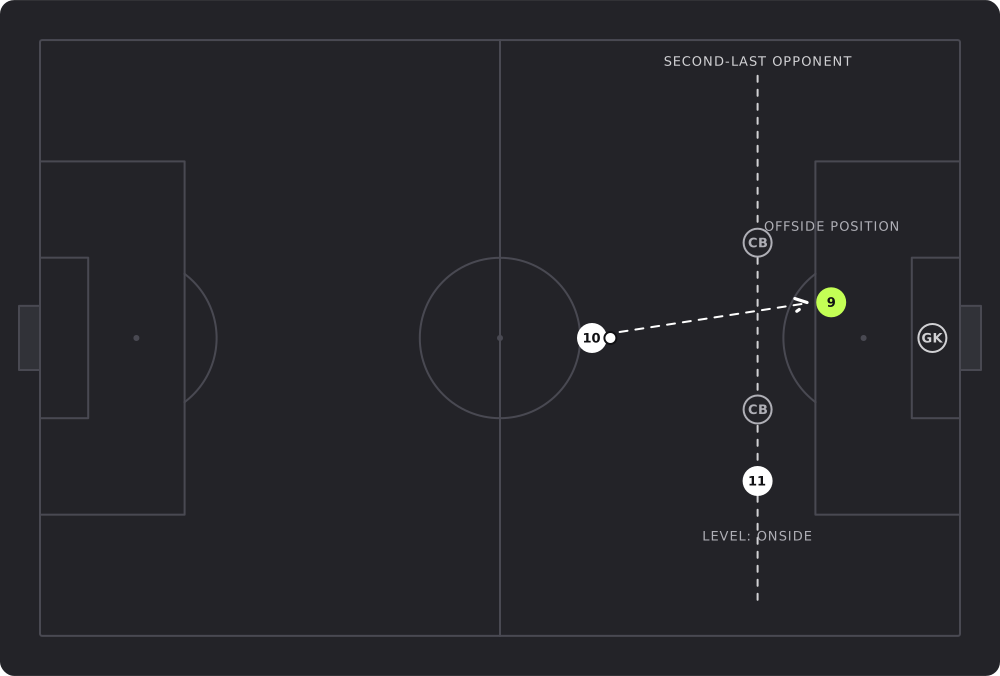
What puts a player in an offside position and what does not. The two-part test: in the opponents' half, excluding the halfway line, and nearer to the opponents' goal line than both the ball and the second-last opponent. The body parts that are measured, any part of the head, body or feet, and the hands and arms, of every player including the goalkeeper, that are not. Being level with the second-last opponent, or with the last two opponents, is not being nearer. The second-last opponent is a position, not always the goalkeeper. Being in an offside position is not an offence by itself. Then applying the line in play: the position is judged at the instant a team-mate plays or touches the ball, a run made after that is timed off the pass, a player behind or level with the ball is not in an offside position, and offside still applies from a free kick.
Test 1The offside position defined
The player must be closer to the opponents' goal line than the ball and than the second-last opponent together, not just one of them.
Source: IFAB Laws of the Game 2026/27, Law 11 · recall
The offside-position test is applied only in the opponents' half, so a player in their own half is outside it entirely.
Source: IFAB Laws of the Game 2026/27, Law 11 · recall
For offside the opponents' half excludes the halfway line itself, so a player level with it is not in an offside position.
Source: IFAB Laws of the Game 2026/27, Law 11 · recall
Level with the second-last opponent is not nearer the goal line than that opponent, so on this measure the player is onside.
Source: IFAB Laws of the Game 2026/27, Law 11 · recall
Any part of the head, body or feet can be in an offside position; the hands and arms are the only parts excluded.
Source: IFAB Laws of the Game 2026/27, Law 11 · recall
Hands and arms are not considered for offside; the boundary of the arm is taken at the bottom of the armpit.
Source: IFAB Laws of the Game 2026/27, Law 11 · recall
The hands and arms of every player, goalkeepers included, are left out when the offside line is drawn.
Source: IFAB Laws of the Game 2026/27, Law 11 · recall
The line is set by whichever opponent is second-nearest the goal line, often the goalkeeper and a defender, sometimes two defenders.
Source: IFAB Laws of the Game 2026/27, Law 11 · recall
An offside position needs the player nearer the goal line than the ball as well as the defenders; level with the ball fails that half.
Source: IFAB Laws of the Game 2026/27, Law 11 · applied
Being in an offside position is not an offence; a free kick follows only once the player becomes involved in active play.
Source: IFAB Laws of the Game 2026/27, Law 11 · recall
Test 2Reading the offside line as the ball is played
Offside position is fixed at the instant a team-mate last plays or touches the ball, not when the pass is finally collected.
Source: IFAB Laws of the Game 2026/27, Law 11 · recall
The forward was level, so onside, at the moment of the pass; a run made after the ball is played creates no offside offence.
Source: IFAB Laws of the Game 2026/27, Law 11 · applied
A player level with or behind the ball is not nearer the goal line than it, so a backward pass cannot leave them in an offside position.
Source: IFAB Laws of the Game 2026/27, Law 11 · applied
Offside position depends only on where everyone is when the ball is played; a defender stepping up puts the forward beyond the line.
Source: IFAB Laws of the Game 2026/27, Law 11 · applied
Only the goal kick, throw-in and corner carry the offside exemption; a free kick is treated like any other pass in play.
Source: IFAB Laws of the Game 2026/27, Law 11 · applied
Offside position is judged player by player: the one level with the second-last opponent is onside, the one beyond is not.
Source: IFAB Laws of the Game 2026/27, Law 11 · applied
Offside concerns the team-mate who may receive the ball; a player cannot be offside from a pass they made themselves.
Source: IFAB Laws of the Game 2026/27, Law 11 · applied
There is no benefit-of-the-doubt margin in the Law: any part beyond the second-last opponent puts the player in an offside position.
Source: IFAB Laws of the Game 2026/27, Law 11 · applied
Offside position is read from the moment the ball was last deliberately played by a team-mate towards the receiver.
Source: IFAB Laws of the Game 2026/27, Law 11 · applied
With the goalkeeper and a defender both nearer the goal line, the attacker is not beyond the second-last opponent, so not offside.
Source: IFAB Laws of the Game 2026/27, Law 11 · applied
11.112The offside offence
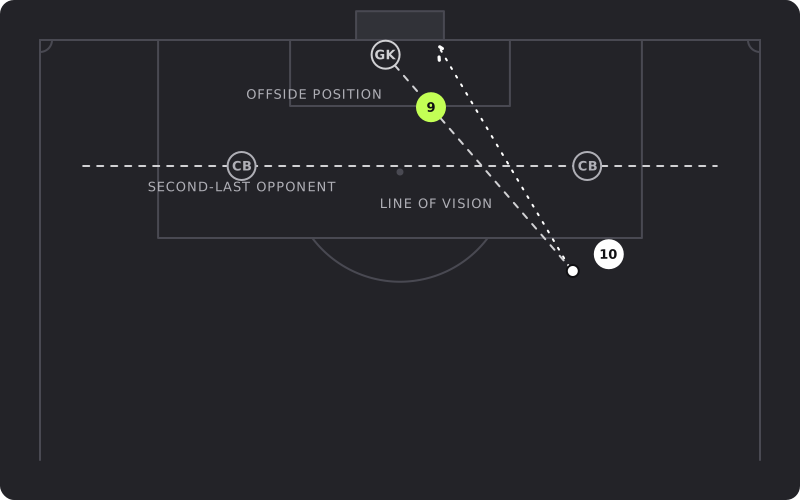
How an offside position becomes an offence: the player becomes involved in active play. Interfering with play means playing or touching a ball passed or touched by a team-mate. Interfering with an opponent means preventing them from playing or being able to play the ball by clearly obstructing the line of vision, challenging for the ball, clearly attempting to play a ball that is close when this impacts an opponent, or making an obvious action that clearly impacts an opponent's ability to play the ball. Gaining an advantage means playing a ball, or interfering with an opponent, when the ball has rebounded or been deflected off the goalpost, the crossbar, a match official or an opponent, or has been deliberately saved by any opponent. A save is stopping, or trying to stop, a ball going into or very close to the goal. A rebound gives no fresh onside status; the position is still read from the team-mate's last touch.
Test 1Interfering with play and with an opponent
The offence is becoming involved in active play, by interfering with play, interfering with an opponent, or gaining an advantage.
Source: IFAB Laws of the Game 2026/27, Law 11 · recall
Interfering with play is defined narrowly as playing or touching a ball that was passed or touched by a team-mate.
Source: IFAB Laws of the Game 2026/27, Law 11 · recall
Clearly obstructing an opponent's line of vision is one of the listed ways of interfering with an opponent, so the goal is disallowed.
Source: IFAB Laws of the Game 2026/27, Law 11 · applied
Challenging an opponent for the ball is one of the listed ways a player interferes with an opponent from an offside position.
Source: IFAB Laws of the Game 2026/27, Law 11 · recall
Clearly attempting to play a ball that is close, when the action impacts an opponent, is an offside offence even with no touch.
Source: IFAB Laws of the Game 2026/27, Law 11 · applied
The list closes with an obvious action by the offside player that clearly affects an opponent's ability to play the ball.
Source: IFAB Laws of the Game 2026/27, Law 11 · recall
Leaving the ball without touching it or impacting an opponent is not becoming involved in active play, so there is no offence.
Source: IFAB Laws of the Game 2026/27, Law 11 · applied
Interfering with play is playing or touching the ball at all; how small the touch is does not change that it happened.
Source: IFAB Laws of the Game 2026/27, Law 11 · applied
An obvious action by the offside striker that clearly impacts the goalkeeper's ability to play the ball is an offside offence.
Source: IFAB Laws of the Game 2026/27, Law 11 · applied
An offside offence needs the player in the offside position to play the ball or interfere; an onside team-mate taking it is fine.
Source: IFAB Laws of the Game 2026/27, Law 11 · applied
Test 2Gaining an advantage from a rebound or a save
Playing a ball that rebounded or deflected off the goalpost, crossbar or a match official, having been offside, is gaining an advantage.
Source: IFAB Laws of the Game 2026/27, Law 11 · recall
A deliberate save by any opponent, not just the goalkeeper, still leaves the offside player gaining an advantage if they then play the ball.
Source: IFAB Laws of the Game 2026/27, Law 11 · applied
A save is an attempt to stop a ball heading into or very close to the goal; an ordinary deliberate play elsewhere is not a save.
Source: IFAB Laws of the Game 2026/27, Law 11 · recall
The striker was in an offside position at the shot and then played the rebound, which is gaining an advantage, so the goal is out.
Source: IFAB Laws of the Game 2026/27, Law 11 · applied
A parry is a deliberate save, and playing the ball from it while having been in an offside position is gaining an advantage.
Source: IFAB Laws of the Game 2026/27, Law 11 · applied
A match official is one of the surfaces listed for gaining an advantage, so playing the ball after it rebounds off the referee is an offence.
Source: IFAB Laws of the Game 2026/27, Law 11 · applied
Gaining an advantage is an offence only for a player who was offside; an onside team-mate finishing the rebound is a valid goal.
Source: IFAB Laws of the Game 2026/27, Law 11 · applied
A rebound or a deliberate save does not reset offside; the position is judged from when the team-mate last played the ball.
Source: IFAB Laws of the Game 2026/27, Law 11 · recall
Gaining an advantage covers playing the ball or interfering with an opponent after a rebound or a save, so jostling the keeper is enough.
Source: IFAB Laws of the Game 2026/27, Law 11 · applied
A deflection is not a deliberate play, so the striker's offside position is not reset and playing the ball is an offence.
Source: IFAB Laws of the Game 2026/27, Law 11 · applied
11.113When there is no offside offence
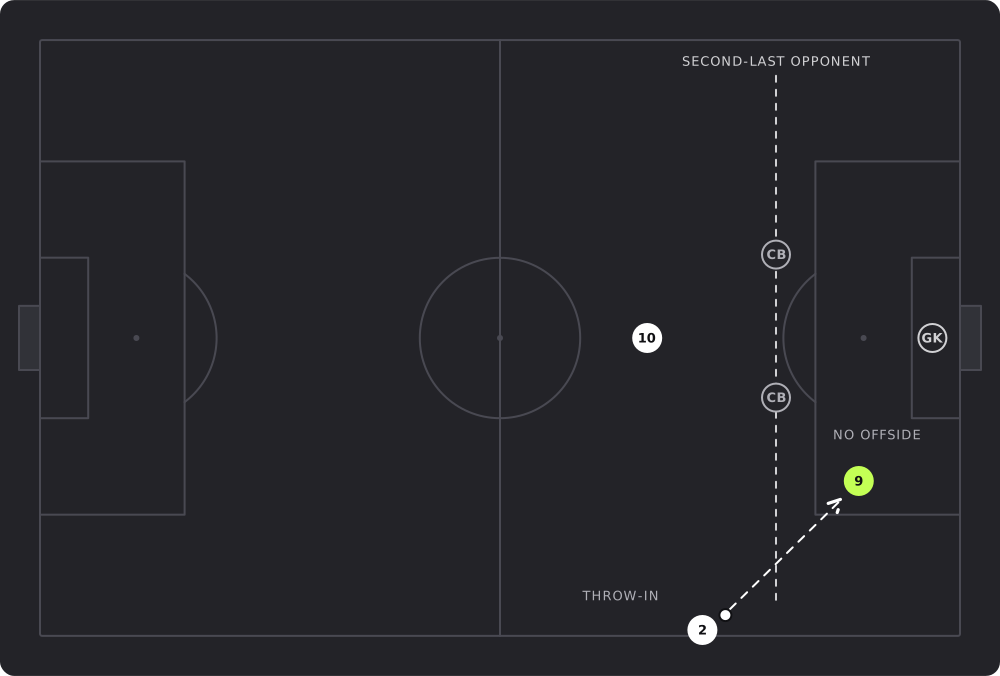
The cases Law 11 takes out of offside. There is no offside offence if a player receives the ball directly from a goal kick, a throw-in or a corner kick. The exemption is for receiving it directly: once a team-mate touches it first, offside is live again for the next phase, and a deflection off an opponent is not the same as receiving it directly. A ball an opponent deliberately plays, a deliberate save aside, resets the position, so a player in an offside position who then receives it is not penalised; a deliberate save does not reset it. Deliberate play means the opponent had control and a clear chance to play the ball, to pass it, gain possession or clear it; a rushed touch under pressure or an unsuccessful control is not deliberate play. Only the goal kick, throw-in and corner are exempt restarts; a dropped ball is not on the list.
Test 1The exempt restarts and the deliberate-play reset
The three exempt restarts are the goal kick, the throw-in and the corner kick; every other restart leaves offside live.
Source: IFAB Laws of the Game 2026/27, Law 11 · recall
Receiving the ball directly from a throw-in carries no offside offence, so the striker's position does not matter for that pass.
Source: IFAB Laws of the Game 2026/27, Law 11 · applied
The exemption is for receiving the ball directly from the corner; once a team-mate plays it, the next pass is judged for offside normally.
Source: IFAB Laws of the Game 2026/27, Law 11 · applied
The corner exemption only covers a ball received directly; a deflection off a defender, which is not a deliberate play, does not carry it over.
Source: IFAB Laws of the Game 2026/27, Law 11 · applied
Only the goal kick, throw-in and corner are exempt; offside applies once a dropped ball is in play and a team-mate plays it forward.
Source: IFAB Laws of the Game 2026/27, Law 11 · recall
When an opponent deliberately plays the ball, a save aside, a player in an offside position who then receives it is not penalised.
Source: IFAB Laws of the Game 2026/27, Law 11 · recall
Deliberate play means the opponent had the ball under control with a clear opportunity to pass it, gain possession or clear it.
Source: IFAB Laws of the Game 2026/27, Law 11 · recall
A hurried, uncontrolled clearance is a deflection, not a deliberate play, so it does not reset the attacker's offside position.
Source: IFAB Laws of the Game 2026/27, Law 11 · applied
A deliberate save is treated apart from a deliberate play: the attacker who then plays the ball is gaining an advantage, so it is an offence.
Source: IFAB Laws of the Game 2026/27, Law 11 · applied
A clean catch and distribution is a deliberate play by an opponent, which resets the position for the attacker who receives it next.
Source: IFAB Laws of the Game 2026/27, Law 11 · applied
11.114Sanction and officiating
What follows an offside offence and how it is judged. The restart is an indirect free kick to the defending team, taken from where the offence occurred, even if that is in the offending player's own half. The assistant referee is usually best placed to judge the line and signals with the flag; on a promising attack the flag may be delayed, wait and see, until the passage of play is over, and a goal scored in the meantime can still be ruled out. VAR may check offside for a goal, a penalty or a red-card incident: the position is a factual matter of where the lines fall, while whether a player was interfering with an opponent is a judgement that is only overturned for a clear and obvious error. A defender who leaves the field of play in the run of play is treated as being on the goal line or touchline for offside until the next stoppage or until the ball is cleared. An attacker off the field is treated as being on the goal line and can be penalised on re-entering and becoming involved.
Test 1The restart and the officials' role
An offside offence is punished with an indirect free kick to the defending team, wherever on the field it occurred.
Source: IFAB Laws of the Game 2026/27, Law 11 and Law 13 · recall
The restart is taken from the spot where the player became involved in active play and so committed the offside offence.
Source: IFAB Laws of the Game 2026/27, Law 11 · recall
Law 11 makes the point explicitly: the indirect free kick is taken where the offence occurred, including in the offending player's own half.
Source: IFAB Laws of the Game 2026/27, Law 11 · applied
The assistant referee runs in line with the second-last opponent and is usually best placed to judge offside, signalling with the flag.
Source: IFAB Laws of the Game 2026/27, Law 11 · recall
On a clear goalscoring chance the flag is delayed until the phase ends; if the attacker was offside the goal is then ruled out.
Source: IFAB Laws of the Game 2026/27, Law 11 · recall
The delayed flag does not validate the goal; once play stops the offside offence is punished and the goal is ruled out.
Source: IFAB Laws of the Game 2026/27, Law 11 · applied
VAR handles offside only within the reviewable categories: goals, penalty incidents and direct red-card incidents.
Source: IFAB Laws of the Game 2026/27, Law 11 · recall
Offside position is a factual check on the lines, while whether the player was interfering is subjective and overturned only for a clear error.
Source: IFAB Laws of the Game 2026/27, Law 11 · recall
A defender off the field in the run of play still counts for the offside line, placed on the goal line, until play stops or the team clears the ball.
Source: IFAB Laws of the Game 2026/27, Law 11 · applied
An attacker off the field is still counted on the goal line for offside, and becoming involved on re-entry can be an offside offence.
Source: IFAB Laws of the Game 2026/27, Law 11 · applied
Sources
IFAB Laws of the Game 2026/27, Law 11 (paraphrased in original wording; original questions authored from the Law, not reproduced)
- IFAB Laws of the Game 2026/27, Law 1159
- IFAB Laws of the Game 2026/27, Law 11 and Law 131