
Football · Laws of the Game
Law 15: The Throw-In
2 parts · 3 tests · 30 facts · updated 6 September 2026 · markdown
Law 15 governs the throw-in, the restart when the whole of the ball passes over a touchline on the ground or in the air. It is awarded to the opponents of the player who last touched the ball. The thrower stands facing the field of play, with part of each foot on the touchline or on the ground outside it, and throws the ball with both hands from behind and over the head, from the point where the ball left the field. The ball is in play as soon as it enters the field of play; if it touches the ground before entering, the same team retakes it from the same position, while a throw-in that is not taken correctly is retaken by the opposing team. The thrower must not touch the ball again until it has touched another player: a second touch is an indirect free kick to the opponents, or a direct free kick, or a penalty kick if it is a deliberate handball inside the thrower's own penalty area. All opponents must stand at least 2 m from the point of the throw-in; one who unfairly distracts or impedes the thrower, including standing closer than 2 m, is cautioned for unsporting behaviour, and if the throw was taken the throwing team gets an indirect free kick. A goal cannot be scored directly from a throw-in, and a player cannot be penalised for offside directly from one. A player who delays the throw-in is given a five-second countdown, after which it passes to the opponents.
15.151The procedure
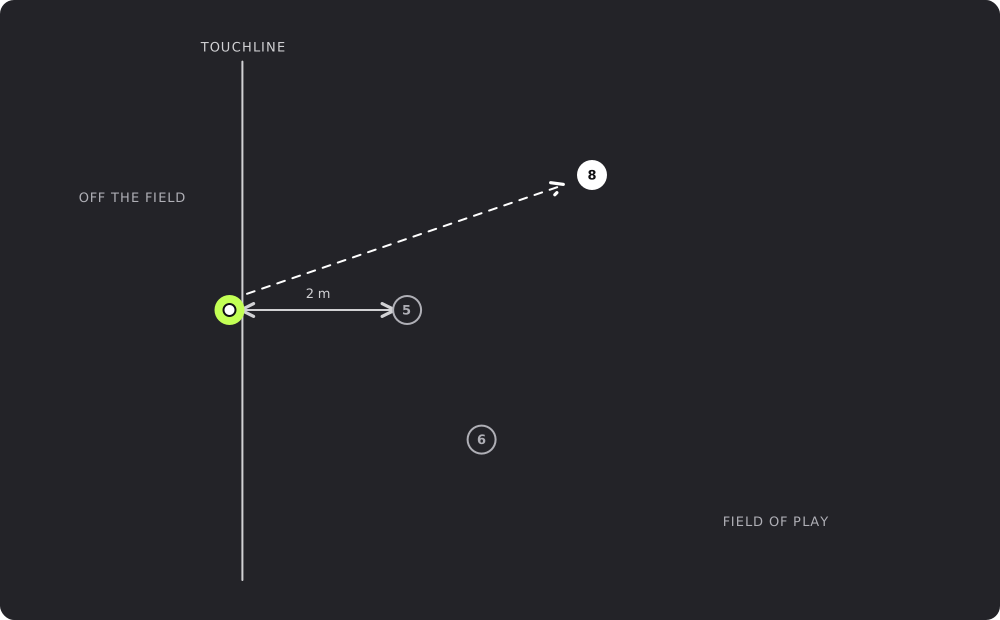
How a throw-in is taken, stated as positive rules with the sanctions left to sub-level 15.152. A throw-in is awarded to the opponents of the player who last touched the ball when the whole of the ball passes over the touchline on the ground or in the air. The thrower stands facing the field of play with part of each foot on the touchline or on the ground outside it, and throws the ball with both hands from behind and over the head, from the point where the ball left the field. The ball is in play as soon as it enters the field of play; if it touches the ground before entering, the same team retakes it from the same position. The thrower must not touch the ball again until it has touched another player. All opponents must stand at least 2 m from the point on the touchline where the throw-in is taken. Any team-mate of that side may take the throw-in, the referee does not signal for it, and it may be taken quickly.
Test 1The stance and the delivery
A throw-in is awarded to the opponents of the player who last touched the ball when the whole of the ball leaves the field over the touchline.
Source: IFAB Laws of the Game 2026/27, Law 15 · recall
The thrower must have part of each foot on the touchline or on the ground outside the touchline as the ball is released.
Source: IFAB Laws of the Game 2026/27, Law 15 · recall
Part of each foot must be on the ground at the moment the ball is thrown, so a throw taken with both feet in the air is a foul throw.
Source: IFAB Laws of the Game 2026/27, Law 15 · applied
The ball must be thrown with both hands; a one-handed throw with the other hand merely steadying the ball is a foul throw.
Source: IFAB Laws of the Game 2026/27, Law 15 · recall
The ball is thrown from behind and over the head; a push from the side or front of the head is a foul throw.
Source: IFAB Laws of the Game 2026/27, Law 15 · recall
The thrower must stand facing the field of play.
Source: IFAB Laws of the Game 2026/27, Law 15 · recall
The throw-in is taken from the point where the ball left the field of play.
Source: IFAB Laws of the Game 2026/27, Law 15 · recall
The ball is in play the moment it enters the field of play, not when it leaves the hands.
Source: IFAB Laws of the Game 2026/27, Law 15 · recall
If the ball touches the ground before entering the field, the throw-in is retaken by the same team from the same position.
Source: IFAB Laws of the Game 2026/27, Law 15 · applied
The thrower must not touch the ball again until it has touched another player.
Source: IFAB Laws of the Game 2026/27, Law 15 · recall
Test 2The other players and the ball's first travel
All opponents must stand at least 2 m from the point on the touchline where the throw-in is taken.
Source: IFAB Laws of the Game 2026/27, Law 15 · recall
Any team-mate of the side awarded the throw-in may take it; it need not be the nearest player.
Source: IFAB Laws of the Game 2026/27, Law 15 · recall
The referee does not need to signal for a throw-in; it may be taken as soon as the ball and thrower are in the right place.
Source: IFAB Laws of the Game 2026/27, Law 15 · recall
The thrower must stand facing the field of play, so a throw-in cannot be taken kneeling or sitting.
Source: IFAB Laws of the Game 2026/27, Law 15 · recall
The ball must be thrown from behind and over the head; releasing it with no throwing action is not a valid throw-in and it passes to the opponents.
Source: IFAB Laws of the Game 2026/27, Law 15 · recall
Standing with part of each foot on the ground outside the touchline is expressly allowed; the thrower need not touch the line.
Source: IFAB Laws of the Game 2026/27, Law 15 · applied
The ball may be thrown in any direction from a throw-in, backwards included; there is no requirement for it to travel forward.
Source: IFAB Laws of the Game 2026/27, Law 15 · recall
Only a delivery that rises up from behind the neck and past the top of the skull satisfies Law 15; a chest drive or a push by the forehead both fail it.
Source: IFAB Laws of the Game 2026/27, Law 15 · applied
A throw-in may be taken quickly; opponents who fail to retreat are punished only if they interfere with or impede the throw.
Source: IFAB Laws of the Game 2026/27, Law 15 · applied
The throw-in goes to the opponents of whoever last touched the ball; the deflection off the attacker was the last touch, so the defenders throw.
Source: IFAB Laws of the Game 2026/27, Law 15 · applied
15.152Infringements and sanctions
What the referee gives when a throw-in rule is broken. A throw-in taken with illegal technique is awarded to the opposing team from the same place, while a throw where the ball never enters the field is retaken by the same team. If the thrower plays the ball a second time before another player touches it, an indirect free kick is awarded to the opponents; if that second touch is a deliberate handball, a direct free kick is awarded, or a penalty kick if it happened in the thrower's own penalty area. A goal cannot be scored directly from a throw-in: into the opponents' goal it is a goal kick, into the thrower's own goal it is a corner kick. A player cannot be penalised for offside directly from a throw-in. An opponent who unfairly distracts or impedes the thrower, including standing closer than 2 m, is cautioned for unsporting behaviour, and if the throw was taken the throwing team gets an indirect free kick. A player who delays the throw-in is given a five-second countdown, after which it passes to the opponents. A goalkeeper who handles a throw-in received directly from a team-mate concedes an indirect free kick under Law 12.
Test 1Foul throws, second touches and interference
A throw-in that is not taken correctly is awarded to the opposing team, taken from the same position.
Source: IFAB Laws of the Game 2026/27, Law 15 · recall
When the ball fails to enter the field, the same team retakes the throw-in; only an incorrectly taken throw passes to the opponents.
Source: IFAB Laws of the Game 2026/27, Law 15 · recall
A second touch by the thrower before another player plays the ball is punished with an indirect free kick to the opposing team.
Source: IFAB Laws of the Game 2026/27, Law 15 · recall
A deliberate handball second touch is a direct-free-kick offence, and inside the thrower's own penalty area that means a penalty kick.
Source: IFAB Laws of the Game 2026/27, Law 15 · applied
A goal cannot be scored directly from a throw-in; into the opponents' goal it is a goal kick, into the thrower's own goal it is a corner.
Source: IFAB Laws of the Game 2026/27, Law 15 · recall
An opponent who distracts or impedes the thrower is cautioned; if the throw was taken, the throwing team gets an indirect free kick.
Source: IFAB Laws of the Game 2026/27, Law 15 · applied
A goalkeeper may not handle the ball received directly from a team-mate's throw-in; the restart is an indirect free kick under Law 12.
Source: IFAB Laws of the Game 2026/27, Law 12 and Law 15 · applied
The referee gives a visible five-second countdown; if the throw-in is still not taken, it is awarded to the opposing team.
Source: IFAB Laws of the Game 2026/27, Law 15 · recall
Part of each foot must stay on the ground or line until the ball is released; a lifted, dragged foot makes it a foul throw.
Source: IFAB Laws of the Game 2026/27, Law 15 · applied
A player cannot be penalised for offside if they receive the ball directly from a throw-in.
Source: IFAB Laws of the Game 2026/27, Law 11 and Law 15 · applied
Sources
IFAB Laws of the Game 2026/27, Law 15 (paraphrased in original wording; original questions authored from the Law, not reproduced)
- IFAB Laws of the Game 2026/27, Law 1528
- IFAB Laws of the Game 2026/27, Law 12 and Law 151
- IFAB Laws of the Game 2026/27, Law 11 and Law 151