
Football · Level 5: Upper-Intermediate · Sub-level 5.6
Attacking Geometry: Half-Spaces & Width
10 tests · 100 facts · updated 6 September 2026 · markdown
Halbraum, false nines, inverted wingers, overlap-versus-underlap, wing-back width, five-corridor pitches, cut-backs and box geometry: how modern teams draw the field to make attack.
Each test below is ten questions on Insporta. The list under a test is what the questions check: one fact per question, with the source it was written from. Read it before the test, or come back from a wrong answer.
Test 1The Geometry Emerges
The word entered global tactical vocabulary via German coaching literature and English-language tactics writers translating it directly.
Source: Tactical terminology · recall
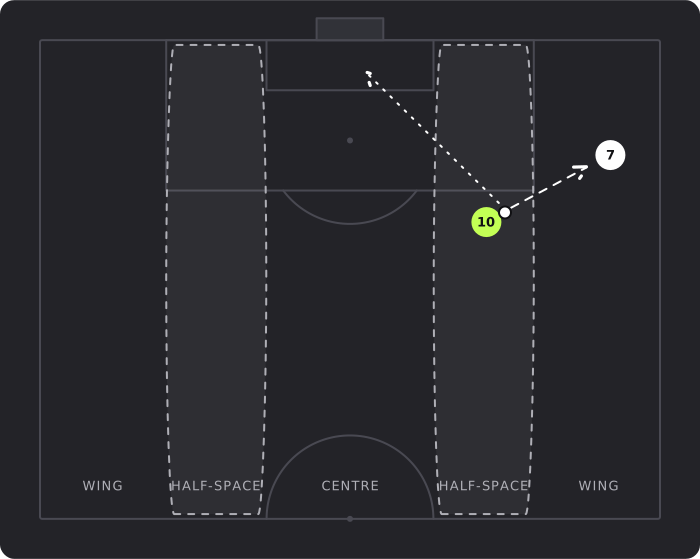
Cutting the pitch into five vertical corridors makes central, half-space and wing zones explicit — the grammar Guardiola's teams drilled.
Source: Tactical literature · recall
German coaches formalised Halbraum as a training and analysis concept; blogs like Spielverlagerung then spread it into English tactical writing.
Source: Tactical history · recall
Guardiola's 6-2 win at the Bernabéu in May 2009 turned the false nine from a historical curiosity into modern football's headline role.
Source: La Liga records / tactical history · recall
Hidegkuti's dropping runs shredded England's WM defence 6-3 at Wembley — the false nine's most influential ancestor.
Source: Football history · recall
David Silva-style inverted attackers helped City end a 44-year league drought and became a template across Europe.
Source: Premier League 2011-12 records · recall
Capello inherited Sacchi's compact zonal ideas but blended them, drilling the width and depth patterns that fed Van Basten and Savićević.
Source: Serie A / tactical history · recall
Liverpool's 4-4-2 hid inside-forward habits: wide starters drifted infield to create central overloads and combinations.
Source: English football history · recall
Cox's narrative places the codification of Halbraum-driven positional play within Germany's 2010s tactical revolution.
Source: Tactical literature (Cox, 'Zonal Marking') · recall
Guardiola has repeatedly named Lillo as the intellectual father of his zonal-grid thinking; the two later reunited at Manchester City.
Source: Guardiola interviews / tactical literature · recall
Test 2The Grammar of Space
Width plus inside occupation is the classic full-back dilemma — the geometry that scores half of modern goals from wide zones.
Source: Tactical literature · applied
The dropping striker forces a choice: follow (open space behind) or hold (concede a free playmaker between the lines).
Source: Tactical literature · applied
Overlaps convert an infield winger into a decoy: the outside runner attacks the space the winger's position created.
Source: Coaching terminology · recall
Underlaps punish full-backs who commit outside to the winger, exploiting the exact gap the touchline duel opens.
Source: Coaching terminology · recall
The wide inside forward gives up the touchline to gain shooting and combining angles from the half-space.
Source: Tactical terminology · recall
Staggering the pitch — different corridors, different heights — is what forces defenders to make choices.
Source: Tactical literature · applied
The pinned full-back is a jailed defender: he cannot help his midfield without opening the touchline highway.
Source: Coaching literature · applied
Cut-backs are the modern era's highest-xG assist type: ground passes to onrushing shooters with the defence facing the wrong way.
Source: Football analytics literature · applied
Third-man runs into the half-space are how positional teams unlock deep blocks — combinations arriving at speed onto a free man.
Source: Tactical literature · applied
Test 3The Geometers
Guardiola's dictum — 'width is the fastest way to move a defence' — became one of the possession school's operational commandments.
Source: Guardiola interviews / tactical literature · recall
Guardiola paired positional-play principles with a classic No.9 for the first time, reshaping half-space geometry around Haaland's finishing.
Source: Premier League 2022-23 records · recall
Mbappé's La Liga move (July 2024) unlocked him in exactly the inside-left channels he had exploited at PSG, feeding on Vinícius' width.
Source: La Liga 2024-25 records · recall
Yamal's outside-in habits from the right half-space powered Barcelona's title and Spain's Euro 2024 triumph.
Source: La Liga / Euro 2024 records · recall
Saka's pinning-plus-underlap partnership with Ben White has become one of Europe's most productive right-side patterns.
Source: Premier League records / tactical literature · recall
Pochettino has repeatedly cited Bielsa's positional and rotational teachings as the foundation of his attacking geometry.
Source: Coaching interviews · recall
De Zerbi's Brighton posted repeated statistical rankings among Europe's most territorially aggressive possession teams.
Source: Premier League 2022-24 records · recall
Frimpong and Grimaldo delivered Bundesliga-record attacking output from wing-back — width as the identity's engine.
Source: Bundesliga 2023-24 records · recall
Ancelotti's Real design deliberately pins Vinícius wide left, treating his 1v1 as a qualitative-superiority weapon.
Source: La Liga records / tactical literature · recall
Kvaratskhelia's arrival in January 2025 completed a structure in which Dembélé's right-half-space combinations were balanced by hard, wide left threat.
Source: UEFA / Ligue 1 records 2024-26 · recall
Test 4Reading the Angles
Compact blocks live on narrowness; the opening operation of a possession team is to make the pitch bigger, not smaller.
Source: Coaching literature · applied
Once the full-back attacks the touchline, the half-space is empty; the underlap steals exactly that vacated corridor.
Source: Coaching literature · applied
If the full-back declines the duel, the half-space becomes the free-man zone — occupation of that corridor is the punishment.
Source: Coaching literature · applied
Overlap and inversion are structural partners: one holds the inside lane, the other guarantees the outside width.
Source: Coaching literature · applied
Back fives sacrifice half-space coverage for width and depth; the modern answer is to hunt exactly those seams.
Source: Coaching literature · applied
The false nine's real threat is the runner behind him: without that follow-up, the drop is a solo trick without a payoff.
Source: Coaching literature · applied
Half-space support turns a trapped touchline winger into a two-player combination that can turn the corner.
Source: Coaching literature · applied
Even on a fast counter, geometry decides outcomes: distinct corridors force defenders to divide their attention.
Source: Coaching literature · applied
Box occupation geometry maps directly to xG: three staggered targets produce far more high-quality chances than one central striker alone.
Source: Football analytics literature · applied
Doubling on one side is a loan the opponent has taken from the opposite corridor; possession's job is to call it in.
Source: Coaching literature · applied
Test 5Geometry Made Visible
Messi's drop between the lines was the game's structural turning point; Barcelona's 6-2 announced the possession era's peak.
Source: La Liga records · recall
England's WM formation had no answer to Hidegkuti's dropping runs; Wembley witnessed the false nine's first great international triumph.
Source: Football history · recall
Rodri's 68th-minute strike from just inside the right half-space completed Manchester City's first treble.
Source: UEFA Champions League 2022-23 records · recall
Yamal's half-space combinations against Kimmich became the tournament's most-replayed geometric evidence.
Source: UEFA Euro 2024 records · recall
Haaland's 36 broke the previous 30-year benchmark, redefining what an orthodox No.9 can produce inside modern half-space geometry.
Source: Premier League records · recall
Joselu's second-leg heroics from delivered half-space entries carried Real to the 2024 final at Wembley.
Source: UEFA Champions League 2023-24 records · recall
Kvaratskhelia's chalk-to-chalk width partnership with Osimhen's box presence powered Napoli's first title since 1990.
Source: Serie A 2022-23 records · recall
The pattern generated one of the Premier League's highest-xG combinations from open play during that title race.
Source: Football analytics literature · recall
Arsenal's structural attack — open-play half-space combinations plus league-leading set-piece geometry — anchored their fourth title.
Source: Premier League 2025-26 records · recall
Barcola's inside-right combinations helped generate a record 5-0 final scoreline against Inter Milan.
Source: UEFA Champions League 2024-25 records · recall
Test 6Geometry in Data
xT-style models weight each pitch zone by its historical link to goals; half-spaces consistently rank near the top for expected next-action value.
Source: Football analytics literature · recall
Touch-map polarity — pure width without half-space presence — is the statistical fingerprint of the classic crossing archetype.
Source: Football analytics literature · applied
Progressive carries in the wide final third capture what heat maps only suggest: real ground gained toward dangerous delivery zones.
Source: Football analytics literature · recall
The half-space assist metric is a direct proxy for the modern positional-play attacking mechanism.
Source: Football analytics literature · applied
Deep completions specifically exclude crosses to isolate the possession-based penetration modern half-space teams live on.
Source: Wyscout definitions · recall
Box entries capture the moment structural attack becomes real threat; teams and coaches use it as a leading indicator of chance creation.
Source: Football analytics literature · recall
Touch maps make roles visible: dropping striker = touches in the '16-16 zone' between penalty areas, not just inside the box.
Source: Football analytics literature · applied
The 'come inside and curl' shot-cluster is the inverted winger's signature statistical output.
Source: Football analytics literature · applied
The possession-plus-entries pair separates dominant possession from decorated circulation — the same lesson positional coaches teach.
Source: Football analytics literature · applied
Test 7Shapes Against Shapes
The difference is where the winger's final action happens — outside for a delivery, or inside for a shot or through pass.
Source: Coaching terminology · recall
Both are 'strikers' on the team sheet; their touch maps and defenders' problems are entirely different.
Source: Tactical literature · applied
The full-back's vector — up the touchline or infield beside the pivot — is one of the clearest signatures of an attacking system.
Source: Coaching terminology · recall
The trade is central security for wide dynamism; wing-backs are the accordion that makes a back three's width work.
Source: Coaching literature · recall
Stagger by role, not by name: the pattern makes one full-back defend two lanes at once, a duel he almost always loses.
Source: Tactical literature · applied
Klopp's model concentrated width in the full-backs, allowing wingers to attack the half-space and near post directly.
Source: Tactical literature · recall
Cross-based attacks challenge the box in the air; half-space attacks challenge it on the ground, from behind — statistically higher xG per shot.
Source: Football analytics literature · applied
Overload-to-isolate is the geometry manual's classic setup: attract the block, then feed the isolated star on the far side.
Source: Tactical literature · recall
Both are attacking shapes; the 3-2-5 buys extra transition protection at the cost of one less midfielder circulator.
Source: Tactical literature · recall
Formations are budgets for space; each shape's balance of width, depth and central presence reveals its attacking assumptions.
Source: Coaching literature · applied
Test 8Geometry Now: 2023-2026
Yamal's back-to-back Kopa awards recognised his role as world football's dominant young half-space operator.
Source: Ballon d'Or / Kopa Trophy records 2024-25 · recall
Grimaldo and Frimpong topped Bundesliga chance-creation charts from wing-back — a title built on the width itself.
Source: Bundesliga 2023-24 records · recall
Arsenal's fourth title was built on Arteta's dual attacking engine — half-space overloads plus a record-breaking set-piece machine.
Source: Premier League 2025-26 records · recall
The right-and-left wide axis of Yamal-Williams gave Spain the width their Euro 2012 side had traded away — geometry, refreshed.
Source: UEFA Euro 2024 records · recall
Flick's geometry — extreme height without the ball, half-space and width with it — produced La Liga's champions in his first season.
Source: La Liga 2024-25 records · recall
Kvaratskhelia's January 2025 arrival completed the wide-width partnership around which PSG's 2025 and 2026 Champions League runs were built.
Source: UEFA Champions League records 2024-26 · recall
The women's semi-finals were one of 2024-25's clearest live demonstrations of half-space play against a modern press.
Source: UEFA Women's Champions League 2024-25 records · recall
Bellingham's La Liga debut season (2023-24, 19 league goals) redefined his role: geometric arrival into the shooting zones behind Vinícius.
Source: La Liga / UEFA records 2023-24 · recall
Tactical evolution is dialectic: once opponents solved the standard 3-2-5, coaches began mixing shapes to restore ambiguity in the last line.
Source: Tactical literature 2025-26 · applied
Bonmatí's back-to-back 2023-24 Ballons d'Or Féminins confirmed her as the women's game's leading half-space geometer.
Source: Ballon d'Or Féminin records / UEFA WCL 2024-25 · recall
Test 9When Geometry Fails
Duplicate corridor occupation is a structural cost with no benefit: two attackers, one defensive answer.
Source: Coaching literature · applied
Inversion without overlap gives the defender a free pass on width — the full-back defends one problem instead of two.
Source: Coaching literature · applied
The false nine's threat depends on runners behind him; without them, the centre-back can safely refuse to follow.
Source: Coaching literature · applied
Flat attacking lines are catastrophic for possession teams: they hand defenders a single freeze-frame to defend everything at once.
Source: Coaching literature · applied
High wide occupation is a loan against transitions; rest defence pays it back only if someone stays home.
Source: Coaching literature · applied
Overload-to-isolate is a two-player contract: someone must abandon touch balance for someone else to stay wide.
Source: Coaching literature · applied
Cross-effectiveness depends on box geometry: near, central and far runners create three problems, not three chances for one clearance.
Source: Football analytics literature · applied
Reception body-shape is critical: half-space touches only become dangerous when the receiver arrives able to play forward.
Source: Football analytics literature · applied
3v3 without lane distribution is really 1v1 three times over; runners must split into distinct corridors to create imbalance.
Source: Coaching literature · applied
Modern geometry requires the credible threat of both routes; single-lane dogma is a scouting report opponents receive for free.
Source: Coaching literature · applied
Test 10Mixed Review: The Field's Grammar
Five corridors, stagger and occupation caps are the operational commandments of modern positional-play geometry.
Source: Tactical literature · applied
The pair splits the flank: winger inside for combinations and shots, full-back outside for width and delivery — Guardiola's blueprint.
Source: Coaching literature · applied
Messi's drop turned a 6-2 result into a permanent structural talking point.
Source: La Liga records / tactical history · recall
Counter-attacking geometry is the same as build-up geometry: distinct corridors force distinct defensive decisions.
Source: Coaching literature · applied
Shot maps are the honest referee of style: inverted wingers' clusters concentrate inside the half-space, orthodox wingers' along the byline.
Source: Football analytics literature · applied
Mancini's title-winning City routinely used David Silva as an inverted wide creator, foreshadowing the next decade of tactical fashion.
Source: Premier League 2011-12 records · recall
Possession without penetration into the half-space and box is exactly the failure mode positional coaches warn against.
Source: Football analytics literature · applied
Both champions concentrated width in wing-backs, allowing inside forwards or two strikers to attack the half-spaces centrally.
Source: Season reviews 2023-24 · recall
A cut-back at speed is positional football's crown jewel — one action executing three lessons of geometry simultaneously.
Source: Football analytics literature · applied
Modern elite attack is a portfolio: half-space combinations, wing-back width, half-space cut-backs and set-piece design all coexist within the same team.
Source: Tactical literature 2023-26 · applied
Sources
IFAB Laws of the Game / UEFA & FIFA technical reports / Opta & StatsBomb definitions / coaching literature
- Coaching literature22
- Football analytics literature18
- Tactical literature12
- Coaching terminology4
- Tactical terminology2
- La Liga records / tactical history2
- Football history2
- Premier League 2011-12 records2
- Guardiola interviews / tactical literature2
- La Liga 2024-25 records2
- Bundesliga 2023-24 records2
- UEFA Euro 2024 records2
- Premier League 2025-26 records2
- Tactical history1
- Serie A / tactical history1
- English football history1
- Tactical literature (Cox, 'Zonal Marking')1
- Premier League 2022-23 records1
- La Liga / Euro 2024 records1
- Premier League records / tactical literature1
- Coaching interviews1
- Premier League 2022-24 records1
- La Liga records / tactical literature1
- UEFA / Ligue 1 records 2024-261
- La Liga records1
- UEFA Champions League 2022-23 records1
- Premier League records1
- UEFA Champions League 2023-24 records1
- Serie A 2022-23 records1
- UEFA Champions League 2024-25 records1
- Wyscout definitions1
- Ballon d'Or / Kopa Trophy records 2024-251
- UEFA Champions League records 2024-261
- UEFA Women's Champions League 2024-25 records1
- La Liga / UEFA records 2023-241
- Tactical literature 2025-261
- Ballon d'Or Féminin records / UEFA WCL 2024-251
- Season reviews 2023-241
- Tactical literature 2023-261