
Football · Level 5: Upper-Intermediate · Sub-level 5.3
Direct & Counter-Attacking Football
10 tests · 100 facts · updated 6 September 2026 · markdown
From Reep and catenaccio to Mourinho, Simeone and Leicester: verticality, transitions, second balls, rest attack, counter metrics — and the modern direct turn of 2025-26.
Each test below is ten questions on Insporta. The list under a test is what the questions check: one fact per question, with the source it was written from. Read it before the test, or come back from a wrong answer.
Test 1Roots of the Direct Game
Reep's pencil-and-paper match coding made him the ancestor of football analytics — and, controversially, of the long-ball doctrine.
Source: Football analytics history · recall
Reep ignored that short moves are simply far more frequent; per-move efficiency tells a different story. The flaw shaped English football for decades.
Source: Football analytics history · recall
Hughes taught that attacks should reach prime scoring positions with minimum passes — the FA's official direct-play doctrine of the 1980s.
Source: FA coaching history · recall
Lawrie Sanchez's header and ferocious directness beat the era's best passing side — direct football's most famous upset.
Source: FA Cup records · recall
Beasant's save from John Aldridge preserved the 1-0 and completed Wimbledon's fairy tale.
Source: FA Cup records · recall
Herrera's Inter defended with a spare man behind the line and struck through lightning counters, above all via Facchetti's forward runs.
Source: Tactical history · recall
Back-to-back European Cups made catenaccio the dominant tactical idea of 1960s Europe.
Source: UEFA official records · recall
Taylor's pressing, long passes and crosses took a fourth-tier club to second in England within five years — direct football's proof of concept.
Source: English football records · recall
In Quiz Ball, teams chose routes to score; Route One — one hard question — became the byword for the direct long ball.
Source: Football culture history · recall
The 'bolt' locked the door in front of goal — a name that captured the system's defensive essence.
Source: Tactical terminology · recall
Test 2Principles of Verticality
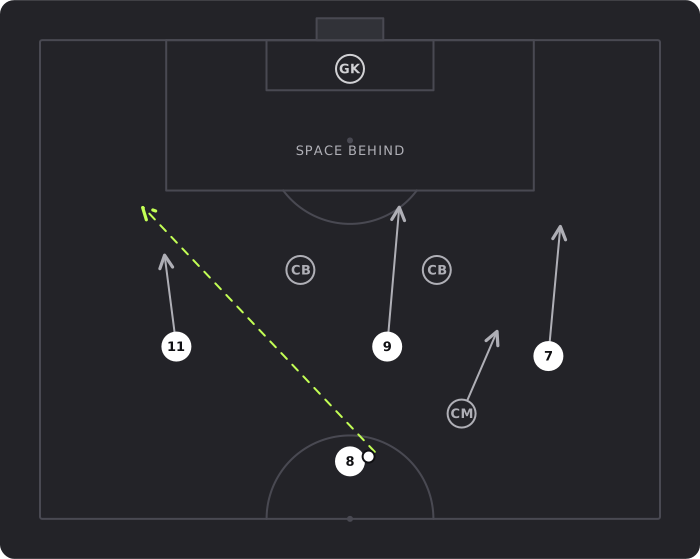
Directness is a choice about speed and verticality; quality direct teams engineer where the ball lands and who arrives around it.
Source: Coaching literature · applied
The first seconds after a regain are when the opponent is most open; the first pass decides whether the counter lives or dies.
Source: Coaching literature · applied
Long-ball football is really second-ball football: the knockdown is worthless unless teammates are structured to collect it.
Source: Coaching literature · applied
The target man converts desperate clearances into controlled possession — the pressure-release valve of the direct game.
Source: Coaching literature · applied
Rest attack mirrors rest defence: the players you leave forward are the counter-attack you have already prepared.
Source: Tactical terminology · applied
Vertical teams measure progress toward goal per pass; sideways safety is tolerated only to set up the next forward strike.
Source: Tactical terminology · applied
Counter or control is a read, not a reflex: with no numerical or spatial edge, the fast attack only donates possession.
Source: Coaching literature · applied
Runners attack the spaces the defenders must choose between; width in transition turns 3v2 into an unsolvable dilemma.
Source: Coaching literature · applied
Transition passes are played into the future; runs to feet kill the speed that makes counters lethal.
Source: Coaching literature · applied
The fastest counters start with the keeper: his throw beats any press because it attacks the moment of maximum disorganisation.
Source: Coaching literature · applied
Test 3Masters of the Counter
Mourinho's Inter conceded the ball on purpose and struck on the break — the modern reference for reactive football at the summit.
Source: Serie A / UEFA records · recall
Atlético's compact 4-4-2 and ruthless transitions took the title from two of the richest squads ever assembled.
Source: La Liga records · recall
The 5000-1 champions rode pace, transitions and organisation to the most improbable title in league history.
Source: Premier League records · recall
Vardy's record run, mostly finishing counters in behind, embodied Leicester's direct identity.
Source: Premier League records · recall
Mahrez supplied the magic on the break; Kanté supplied the regains that launched it.
Source: PFA records · recall
Rehhagel's Greece beat the hosts Portugal twice, defending with man-marking discipline and striking from dead balls and breaks.
Source: UEFA records · recall
With the tournament's fastest weapon in Mbappé, France conceded the ball willingly and attacked space instead of building slowly.
Source: FIFA 2018 technical observations · recall
Forest thrived by conceding the ball, defending compactly and breaking at speed — a modern counter-attacking success story.
Source: Premier League 2024-25 season reviews · recall
Vinícius' pace in behind made Real lethal in transition, from La Liga sprints to Champions League finals.
Source: La Liga / UEFA records · recall
Pulis' Stoke weaponised physicality, set pieces and Rory Delap's throw-ins — direct football as siege warfare.
Source: Premier League history · recall
Test 4Transition Decisions
Isolated centre-backs with open flanks is the exact picture counters exist to punish; hesitation lets the picture close.
Source: Coaching literature · applied
Counters are conditional weapons: against a prepared rest defence, control beats speed.
Source: Coaching literature · applied
Committing a defender is what converts 3v2 into 2v1: pass too early and both defenders stay useful.
Source: Coaching literature · applied
Without second-ball structure, direct play becomes a donation scheme; proximity around the duel is non-negotiable.
Source: Coaching literature · applied
Deep defending is often bait: every opponent who pushes up personally enlarges the counter-attacking runway.
Source: Coaching literature · applied
Pace versus a high line is the cleanest mismatch in football; the early ball converts it before the picture changes.
Source: Coaching literature · applied
Transition width is about occupying separate corridors so each defender faces his own private emergency.
Source: Coaching literature · applied
Counter-attacking is space-dependent: two reactive teams create stalemates that only alternative chance-creation routes break.
Source: Coaching literature · applied
Set-piece defence with rest attack is a loaded spring; the keeper's first decision releases or wastes it.
Source: Coaching literature · applied
The rest attack defends by existing: opponents must leave guards, and every clearance can become thirty seconds of relief.
Source: Coaching literature · applied
Test 5Counter-Attacking Classics
Inter absorbed possession and struck through Sneijder, Maicon and Milito — reactive football's statement win over the era's best.
Source: UEFA official records · recall
Reduced to ten from the 28th minute, Inter defended a 1-0 defeat to advance 3-2 on aggregate — Mourinho's defensive masterpiece.
Source: UEFA official records · recall
Both goals came from direct, vertical attacks — the counter-puncher's crowning night.
Source: UEFA official records · recall
Chelsea parked the bus, waited, and converted the season's most infamous mistake into a title-deciding counter-attacking win.
Source: Premier League records · recall
Ramos struck twice from dead balls and Ronaldo twice more, one on a devastating break — possession met its counter-argument.
Source: UEFA official records · recall
Rehhagel's men scored from a set piece and defended the lead with iron discipline — the ultimate underdog blueprint.
Source: UEFA official records · recall
The champions-elect blended set-piece power and transition menace to dismantle the title favourites in their own stadium.
Source: Premier League records · recall
The 19-year-old's sixty-metre burst and two finishes made him the tournament's face and transition football's new archetype.
Source: FIFA official records · recall
Needing a point away to their direct rivals, Simeone's men equalised from a corner — set pieces and defiance in one image.
Source: La Liga records · recall
Dortmund dominated early, but Real's set-piece and transition ruthlessness decided Wembley — efficiency as identity.
Source: UEFA official records · recall
Test 6Counting the Counter
Fast-break counts let analysts quantify how often a team converts turnovers into immediate attacks.
Source: Opta definitions · recall
Leicester proved elite outcomes without the ball: regains, vertical passes and Vardy's runs replaced circulation.
Source: Premier League 2015-16 data · recall
For direct teams, second-ball dominance is the difference between sustained pressure and constant turnovers.
Source: Football analytics literature · recall
Transitions are football's sprint races; physical data maps exactly onto the tactical moment counters live in.
Source: Sports science literature · recall
Style and quality are separate axes: low possession with superior chance quality is a working identity, not a failure.
Source: Football analytics literature · applied
High direct speed plus low possession is the statistical fingerprint of counter-attacking football.
Source: Opta definitions · applied
Volume versus quality is the central trade: ten counters can out-produce twenty-five blocked-box attempts.
Source: Football analytics literature · applied
Elite counter sides shoot within seconds of regains; the clock from turnover to attempt is their signature metric.
Source: Football analytics literature · applied
Passive pressing numbers are not a weakness here but a choice: the plan is to defend space, not hunt the ball.
Source: Football analytics literature · applied
Test 7Reactive Football, Compared
Same moment, opposite direction: what you do the instant possession changes defines which transition you are playing.
Source: Tactical literature · applied
The bolt was personal: each marker had his man plus a spare sweeper; today's blocks protect spaces, not shirts.
Source: Tactical history · recall
Geography defines the styles: one hunts the ball at the source, the other ambushes it at the destination.
Source: Tactical literature · recall
Both lifted the same trophy from statistical opposite poles — the strongest argument that style is a means, not a law.
Source: Premier League records / analytics · applied
Directness has dialects: the long throw and the through ball share verticality but exploit entirely different weaknesses.
Source: Tactical literature · applied
For reactive teams the deep block is not suffering but seduction: the opponent's ambition is the weapon.
Source: Tactical literature · recall
Elite teams pre-load both transitions: the structure you keep 'in reserve' decides who wins the moment possession flips.
Source: Tactical terminology · recall
Counters and dead balls both manufacture chances without needing the ball for long — the reactive team's twin engines.
Source: Tactical literature · recall
The lesson of the extremes: tournaments reward coherence and conviction, in whichever direction they point.
Source: UEFA records / tactical literature · applied
Reactive football is a philosophy, not an emergency measure: the block is the identity, the counter its voice.
Source: Tactical literature · recall
Test 8The Direct Turn: 2023-2026
With more long balls and shorter sequences league-wide, 2025-26 marked a clear turn toward directness in England.
Source: Opta Analyst / Premier League 2025-26 trends · recall
Brentford committed hardest to the rediscovered weapon, with Michael Kayode delivering the vast majority.
Source: Opta Analyst 2025-26 · recall
Kayode out-threw every other Premier League player by at least seventeen deliveries — a specialist's workload.
Source: Opta Analyst 2025-26 · recall
Grønnemark's move signalled that even the champions-elect saw untapped value in the game's most direct restart.
Source: Opta Analyst 2025-26 · recall
A once-mocked weapon was suddenly producing at a meaningful rate, feeding the league's broader direct turn.
Source: Opta Analyst 2025-26 · recall
Japan sat deep, conceded the ball and scored four on the break — a pure stylistic ambush of the eventual champions.
Source: FIFA Women's World Cup 2023 records · recall
Mbappé's transition running remained Europe's most feared weapon, even as PSG lifted the trophy itself.
Source: UEFA Champions League 2025-26 records · recall
More long balls with fewer and slower breaks points to risk-aversion on both sides of the ball, not to a counter boom.
Source: Opta Analyst / Premier League 2025-26 trends · applied
Regragui's Morocco conceded one goal (an own goal) before the semis while breaking with pace — reactive football's tournament masterpiece.
Source: FIFA 2022 records · recall
Tactics evolve dialectically: once everyone pressed, bypassing the press became the market's most undervalued idea.
Source: Opta Analyst / tactical literature · applied
Test 9When the Counter Backfires
Transition cuts both ways: the more bodies your counter borrows, the bigger the loan the opponent can call in.
Source: Coaching literature · applied
Counters run on a clock measured in seconds; once the picture closes, forcing it only manufactures a turnover.
Source: Coaching literature · applied
Territory has a price: permanent siege exposes a side to variance no organisation fully controls.
Source: Tactical literature · applied
Direct play without duel and knockdown dominance is just an expensive way to give the opponent the ball.
Source: Coaching literature · applied
When the opponent has pre-solved your transitions, insisting on them plays into their plan; the route to goal must change.
Source: Coaching literature · applied
Repeated maximal sprinting is the game's most injurious action; transition football without rotation eats its own weapons.
Source: Sports science literature · applied
Abandoning all attacking threat lets the opponent commit everything; even low-quality chances equalise eventually if they never stop.
Source: Tactical / analytics literature · applied
The target man is a relay station, not a soloist; support distance decides whether his duels create anything.
Source: Coaching literature · applied
Transition runs are timed against the passer's foot, not the defender's line; curving the run keeps speed and legality together.
Source: Coaching literature · applied
Counter-attacking is parasitic on opposition ambition; deprived of a host, the style starves until someone blinks.
Source: Tactical literature · applied
Test 10Mixed Review: The Vertical Mind
Forward-first passing and second-ball hunger are the direct game's core commandments.
Source: Coaching literature · applied
Low share, high output: the reactive blueprint working exactly as designed.
Source: Football analytics literature · applied
Reep's counting was pioneering; his interpretation launched decades of long-ball orthodoxy before analytics corrected the record.
Source: Football analytics history · applied
Mourinho aimed the phrase at Tottenham in 2004; football's irony assigned him the bus keys for posterity.
Source: Premier League history · recall
Late-game rest attack exists for this exact moment: the fastest route from siege to sanctuary runs through the keeper's arm.
Source: Coaching literature · applied
The two great upsets share a spine: compact defending, dead-ball threat and merciless counters.
Source: Tactical literature · applied
Transition chains stack disorganisation on disorganisation; the second flip finds almost nobody in position.
Source: Tactical literature · applied
The scoreline is the syllabus: space behind a dominant team is the one resource it cannot help offering.
Source: FIFA Women's World Cup 2023 records · applied
Nine seconds from turnover to attempt is the counter-attacker's pulse; no other style produces that clock.
Source: Football analytics literature · applied
Fewer passes, more launches — the data's before-and-after picture of a league changing its mind about how to attack.
Source: Opta Analyst / Premier League 2025-26 trends · applied
Sources
IFAB Laws of the Game / UEFA & FIFA technical reports / Opta & StatsBomb definitions / coaching literature
- Coaching literature26
- Tactical literature10
- Football analytics literature8
- UEFA official records7
- Tactical terminology4
- Premier League records4
- Opta Analyst 2025-264
- Football analytics history3
- Opta Analyst / Premier League 2025-26 trends3
- FA Cup records2
- Tactical history2
- La Liga records2
- Premier League history2
- Opta definitions2
- Sports science literature2
- FIFA Women's World Cup 2023 records2
- FA coaching history1
- English football records1
- Football culture history1
- Serie A / UEFA records1
- PFA records1
- UEFA records1
- FIFA 2018 technical observations1
- Premier League 2024-25 season reviews1
- La Liga / UEFA records1
- FIFA official records1
- Premier League 2015-16 data1
- Premier League records / analytics1
- UEFA records / tactical literature1
- UEFA Champions League 2025-26 records1
- FIFA 2022 records1
- Opta Analyst / tactical literature1
- Tactical / analytics literature1