
Futsal · Level 3: Pre-Intermediate · Sub-level 3.3
Attacking Play
5 tests · 50 facts · updated 6 September 2026 · markdown
This sub-level teaches rotation used specifically to unbalance the defence, not just to occupy space; the give-and-go, parallel and diagonal, and what separates them; blocks and screens, and the legal line between a screen and a foul; the overload and the flying goalkeeper as one particular way of creating a five-versus-four; and finishing at the far post, where the earlier ideas' created space actually gets converted.
Each test below is ten questions on Insporta. The list under a test is what the questions check: one fact per question, with the source it was written from. Read it before the test, or come back from a wrong answer.
Test 1Rotation to Unbalance the Defence
A successful rotation's real effect is dragging defenders out of their preferred shape, opening gaps rather than guaranteeing any specific outcome.
Source: General futsal coaching · recall
The value of a marking mix-up is the brief window it creates, not any lasting or automatic reward.
Source: General futsal coaching (synthesis) · applied
Individual marking ties a defender to a specific attacker, so that attacker's movement can drag the marker out of position; zonal defenders hold their area instead.
Source: General futsal coaching · recall
A predictable rotation loses its disorienting effect once a well-organised defence has seen it enough times to read it.
Source: General futsal coaching (synthesis) · applied
Simply filling space is passive; rotating specifically to unbalance targets pulling defenders out of their preferred shape.
Source: General futsal coaching (contrast) · recall
Since the fixo's normal job is protecting central space, dragging him out wide directly opens that central area.
Source: General futsal coaching (synthesis) · applied
Creating an unbalanced defence is not the final goal; it exists to be exploited for a better attacking opportunity afterward.
Source: General futsal coaching · recall
A rotation's tactical value depends on someone actually exploiting the gap it creates; the movement alone isn't enough.
Source: General futsal coaching (synthesis) · applied
Zonal marking's core idea, holding an area rather than a specific player, resists being dragged out of shape by rotation better than individual marking does.
Source: General futsal coaching (contrast) · recall
A successful rotation creates an opportunity; whether that opportunity becomes a goal depends on separate factors like finishing, a distinct issue from the rotation's own tactical value.
Source: General futsal coaching (synthesis) · applied
Test 2The Give-and-Go — Parallel and Diagonal
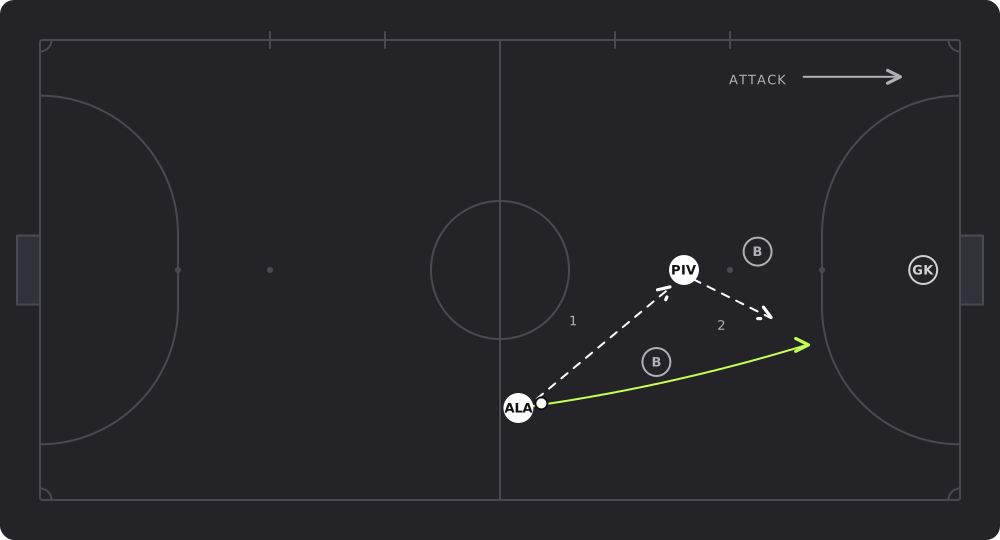
A give-and-go is passing the ball to a team-mate and immediately running into space to receive it back.
Source: General futsal coaching · recall
Running in a straight line alongside the original path, rather than cutting across at an angle, is what defines the parallel version.
Source: General futsal coaching · applied
The diagonal give-and-go's defining feature is the angled run across the defender's path, rather than a straight parallel run.
Source: General futsal coaching (contrast) · recall
Cutting diagonally behind a defender is specifically about getting into a more dangerous position than a straight parallel run would reach.
Source: General futsal coaching (synthesis) · applied
The move depends on the passer's immediate run into space; standing still defeats the purpose of the give-and-go.
Source: General futsal coaching · recall
Reading and stepping into the return passing lane specifically denies that one option, without necessarily eliminating every other option the attackers have.
Source: General futsal coaching (synthesis) · applied
The diagonal give-and-go's angled run is specifically what threatens to get a player behind his marker; a parallel run stays alongside instead.
Source: General futsal coaching (synthesis) · recall
The defining feature of a give-and-go is the original passer moving to receive the ball back, not merely any two-pass exchange.
Source: General futsal coaching (contrast) · applied
On a tight court, the short passing distances mean a defender often can't recover in time to stop the quick return pass.
Source: General futsal coaching · recall
Chaining different give-and-go variants together compounds the difficulty for defenders trying to track the ball and its runners.
Source: General futsal coaching (synthesis) · applied
Test 3Blocks and Screens
A block or screen uses an attacker's own body, legally positioned, to get in the way of a defender's path.
Source: General futsal coaching · recall
A legally positioned, stationary attacker obstructing a defender's path is exactly what a screen is for.
Source: General futsal coaching (synthesis) · applied
A legal screen involves an attacker occupying space without impeding the defender by moving into him; actively blocking his path with movement crosses into a foul.
Source: General futsal coaching · recall
The value of a clean screen is the small window of space or time it buys a team-mate, not any guaranteed reward.
Source: General futsal coaching (synthesis) · applied
Blocks and screens are especially common around set pieces and tight combinations near goal, where small advantages matter most.
Source: General futsal coaching · recall
Deliberately standing in a defender's path to free a team-mate's run is exactly the definition of a screen, here used at a corner.
Source: General futsal coaching (synthesis) · applied
A screen is often set away from the ball, in anticipation of a coming pass or run, not necessarily right on top of it.
Source: General futsal coaching · recall
A screen relies on a legally positioned body blocking a path; a rotation relies on players actually exchanging positions, a different mechanism entirely.
Source: General futsal coaching (contrast) · applied
The main risk is crossing the line from legally standing in the way to actively impeding or moving into the defender, which is a foul.
Source: General futsal coaching (synthesis) · recall
Combining a screen with a give-and-go run stacks two small advantages, the blocked path and the angled run, to make the move harder to defend.
Source: General futsal coaching (synthesis) · applied
Test 4The Overload and the Flying Goalkeeper
An overload means outnumbering the defence in a particular zone, giving the attacking side a numerical advantage there.
Source: General futsal coaching · recall
Three attackers against two defenders in one area is a textbook local overload, though it still needs to be exploited to produce a goal.
Source: General futsal coaching (synthesis) · applied
The flying goalkeeper sees the goalkeeper leave his line to effectively become an outfield attacker, overloading the opponents five against four.
Source: General futsal coaching · recall
With the goalkeeper committed forward, losing the ball leaves the goal empty and exposed to an immediate counter-attack.
Source: General futsal coaching (synthesis) · applied
The flying goalkeeper is a situational tactic, most commonly used late in a match when a team needs a goal and accepts the extra risk.
Source: General futsal coaching · recall
An overload's numbers alone don't produce anything; the extra player still has to move into space to make the advantage count.
Source: General futsal coaching (synthesis) · applied
Adding the goalkeeper to the four outfield attackers makes five, against the opponents' four outfield players, hence the five-versus-four description.
Source: General futsal coaching (synthesis) · recall
An overload is an opportunity, not a guarantee; poor execution can waste even a clear numerical advantage.
Source: General futsal coaching (contrast) · applied
The flying goalkeeper is a specific method of creating an overload, using the goalkeeper as the extra attacker; overload itself is the broader, more general idea.
Source: General futsal coaching (synthesis) · recall
Creating a numerical edge in one zone inevitably means fewer players are available to cover other areas, the basic trade-off behind any overload.
Source: General futsal coaching (synthesis) · applied
Test 5Finishing at the Far Post and Putting It Together
Far-post finishing describes an attacker timing a run to the post furthest from the ball to meet a cross or cutback.
Source: General futsal coaching · recall
Arriving at the post furthest from where the ball was delivered is precisely a far-post run.
Source: General futsal coaching (synthesis) · applied
Attention naturally gathers around the ball's near side, so an unmarked runner arriving at the far post can catch defenders and the goalkeeper out of position.
Source: General futsal coaching · recall
The sequence strings together rotation, a screen and a far-post run, showing how this sub-level's individual ideas combine in a real attack.
Source: General futsal coaching (synthesis) · applied
Far-post finishing is about the run and arrival to convert a delivery; the give-and-go is a passing combination, a different phase of the attack.
Source: General futsal coaching (contrast) · recall
The overload's numerical advantage created the opportunity that the far-post run then converted, showing how the two ideas connect in practice.
Source: General futsal coaching (synthesis) · applied
Every idea in this sub-level either creates an attacking advantage (rotation, give-and-go, screens, overload) or converts one (far-post finishing).
Source: General futsal coaching (purpose, synthesis) · recall
One is a single named example; the other is the general principle it happens to sit under, not a pair of interchangeable labels.
Source: General futsal coaching (contrast) · applied
Of these ideas, only the screen depends on a stationary, legally positioned body obstructing a path; the others rely on movement or positioning elsewhere.
Source: General futsal coaching (synthesis) · recall
Pairing a space-creating idea, like an overload or rotation, with far-post finishing mirrors how these tactics actually combine in a real attacking sequence.
Source: General futsal coaching (synthesis) · applied
Sources
FIFA Futsal Coaching Manual (2025), chapters 10-13, for the skills and tactics this level covers, supplemented by well-established general futsal coaching knowledge where the manual itself isn't pinned down to a specific figure or clause. This level is softer and more judgement-based than Levels 1-2's Law citations.
- General futsal coaching (synthesis)25
- General futsal coaching16
- General futsal coaching (contrast)8
- General futsal coaching (purpose, synthesis)1