
Futsal · Level 3: Pre-Intermediate · Sub-level 3.2
Positions and Formations
5 tests · 50 facts · updated 6 September 2026 · markdown
This sub-level teaches the four positions, goleiro, fixo, ala and pivô, and the job each one does; the three base formations, the 4-0 (fully rotating), the 3-1 (a fixed pivô ahead of three), and the 2-2 (simple, no specialist pivô needed); named rotation patterns, the Y and the L, and what a rotation is generally for; why width matters even on a narrow court; and what "playing through the pivô" means as a way of organising an attack.
Each test below is ten questions on Insporta. The list under a test is what the questions check: one fact per question, with the source it was written from. Read it before the test, or come back from a wrong answer.
Test 1The Four Positions
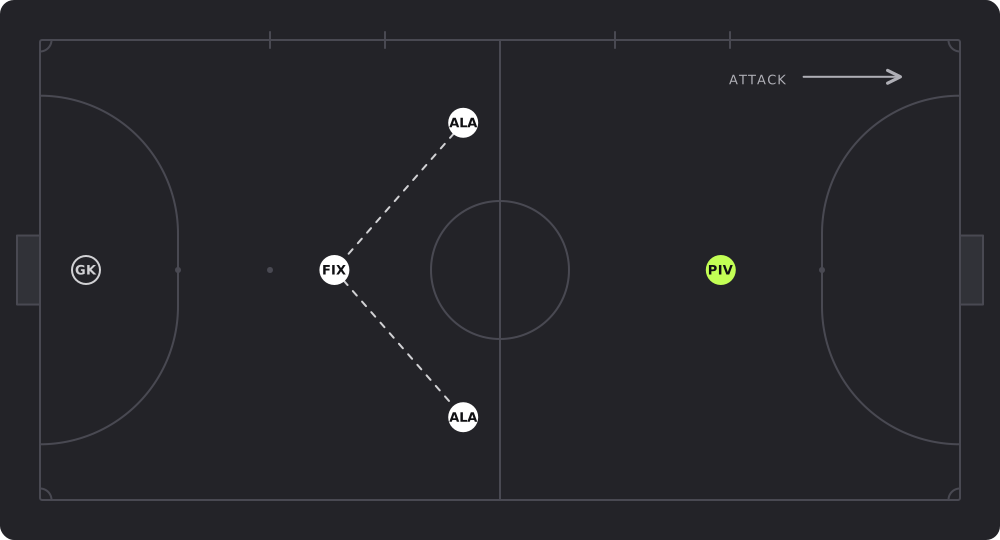
"Fixo" is Portuguese for "fixed," reflecting that this defender is usually found holding the back of the team's shape.
Source: General futsal coaching · recall
The pivô is futsal's target player, receiving with his back to goal to hold up play and bring others into it.
Source: General futsal coaching · applied
A team typically fields two alas, left and right, giving the team width on a narrow court.
Source: General futsal coaching · recall
The modern goleiro's job has grown beyond shot-stopping to include launching attacks and, in special situations, playing outfield.
Source: General futsal coaching · applied
The fixo's main defensive priority is shielding the space in front of the goalkeeper, particularly against the opposing pivô.
Source: General futsal coaching · recall
The ala role rewards pace and dribbling in wide one-on-one situations, exactly this player's profile.
Source: General futsal coaching · applied
Dealing with the opposing pivô is treated as the fixo's main defensive priority.
Source: General futsal coaching · recall
Since the fixo's job includes shielding the goalkeeper, pushing forward creates exactly that gap if the ball is lost.
Source: General futsal coaching (synthesis) · applied
The goleiro alone may use his hands, and only inside his own penalty area.
Source: General futsal coaching · recall
The pivô's job (holding up play, back to goal, centrally) and the ala's job (width, pace, wide one-on-ones) are genuinely different roles.
Source: General futsal coaching (contrast) · applied
Test 2Base Formations — 4-0, 3-1 and 2-2
The 3-1 sets three outfield players across the back line with a single pivô ahead of them.
Source: General futsal coaching · recall
The 2-2, splitting evenly into two defenders and two attackers, is often chosen precisely because it doesn't require a dedicated pivô.
Source: General futsal coaching · applied
The 4-0 base has no fixed roles among the four outfield players, who instead rotate freely.
Source: General futsal coaching · recall
Losing the single pivô doesn't force a rebuild of the back three itself; a team can hold its defensive shape while attacking with fewer players forward.
Source: General futsal coaching (synthesis) · applied
The 3-1 is widely regarded as futsal's most common base formation.
Source: General futsal coaching · recall
The 4-0's entire premise is free rotation among all four outfield players, exactly this interchangeable philosophy.
Source: General futsal coaching · applied
The 2-2's simplicity, not needing a dedicated pivô, is exactly why newer or less specialised teams often favour it.
Source: General futsal coaching · recall
The 3-1's pivô is a fixed target; the 4-0 has no real equivalent, since all four players rotate.
Source: General futsal coaching (contrast) · applied
The numbers in 4-0, 3-1 and 2-2 all describe the four outfield players; the goalkeeper sits outside every one of these names.
Source: General futsal coaching (synthesis) · recall
Teams routinely adjust their base formation during a match to suit the score, opponent or moment, rather than being locked in from kick-off.
Source: General futsal coaching (synthesis) · applied
Test 3Rotations — the Y and the L
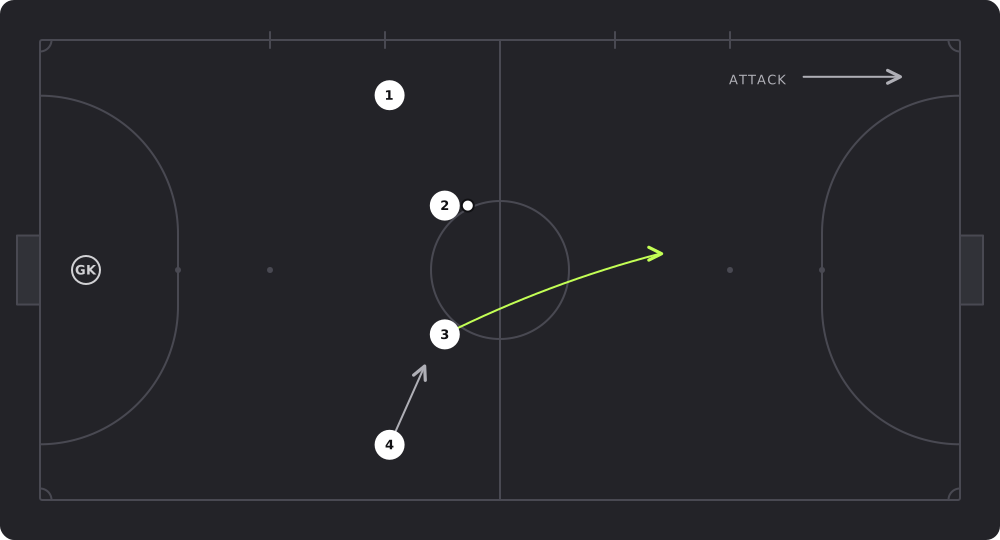
A rotation is a coordinated movement pattern where players exchange positions, aiming to unbalance the defence or open space.
Source: General futsal coaching · recall
A rotation whose player movements trace a Y shape is named after that letter.
Source: General futsal coaching · applied
The L rotation traces an L-shaped movement pattern, commonly used to draw a defender out and open space behind or elsewhere.
Source: General futsal coaching · recall
Drawing defenders toward the ball is valuable precisely because it opens space elsewhere, not because of any automatic reward.
Source: General futsal coaching (synthesis) · applied
Nothing links them beyond both being named rotations; the actual shapes they trace on the court are unrelated.
Source: General futsal coaching (contrast) · recall
The L rotation's own defining shape, running into a corner before cutting back, is exactly what draws a defender out of position that way.
Source: General futsal coaching (synthesis) · applied
Every rotation pattern shares the same underlying purpose: unbalancing the defence to create space or an advantage somewhere on the court.
Source: General futsal coaching (synthesis) · recall
The Y and the L are specific, named shapes; a simple, unstructured swap between two players isn't automatically one of them.
Source: General futsal coaching (contrast) · applied
With a fixed pivô as a reference point, the 3-1 gives rotations like the Y a stable target to build the pattern around.
Source: General futsal coaching (synthesis) · recall
Like any set pattern, a rotation loses its unbalancing effect once opponents learn to read and anticipate it.
Source: General futsal coaching (synthesis) · applied
Test 4Width on a Narrow Court
Even on a narrow court, using the full width stretches the defence horizontally, opening space centrally that a compact defence would otherwise deny.
Source: General futsal coaching · recall
Alas standing centrally rather than out near the touchline give up the stretching effect that width against a compact defence provides.
Source: General futsal coaching (synthesis) · applied
The ala's wide positioning is exactly what gives a team its width, in contrast with the more central fixo, pivô and goleiro.
Source: General futsal coaching · recall
Staying narrow protects the dangerous central areas at the cost of conceding space out wide, exactly the trade-off on offer here.
Source: General futsal coaching (synthesis) · applied
Stretching defenders wide can loosen the pressure around a central pivô, since fewer defenders remain free to double up on him.
Source: General futsal coaching (synthesis) · recall
If nobody replaces the alas out wide when they drift inside, the team loses the very stretching effect width was providing.
Source: General futsal coaching (synthesis) · applied
Even a modest literal distance can stretch a defence's shape meaningfully on a narrow court, which is the real point of width there.
Source: General futsal coaching (synthesis) · recall
A smaller court doesn't remove the value of width; it simply means the same stretching effect happens over shorter distances.
Source: General futsal coaching (contrast) · applied
The fixo and the pivô both operate centrally by design, leaving the width-providing job to the alas out on the flanks.
Source: General futsal coaching (synthesis) · recall
Hugging the touchline is a direct instruction to preserve width, keeping the defensive shape stretched rather than narrowing it.
Source: General futsal coaching (synthesis) · applied
Test 5Playing Through the Pivô and Putting It Together
Playing through the pivô means routing attacking moves via passes into him, using his hold-up play to bring team-mates into the attack.
Source: General futsal coaching · recall
With enough space, a pivô can turn and drive at goal himself rather than needing the usual hold-up-and-lay-off sequence.
Source: General futsal coaching (synthesis) · applied
Of the three bases, only the 3-1 fixes a single dedicated pivô as a consistent target to play through.
Source: General futsal coaching (synthesis) · recall
Marking the opposing pivô tightly is described earlier in this sub-level as specifically the fixo's job.
Source: General futsal coaching (synthesis) · applied
Playing through the pivô is defined around a fixed central target; a Y rotation can, in principle, be run without one.
Source: General futsal coaching (contrast) · recall
Width and playing through the pivô work together: width stretches defenders away from the middle, easing the path for central passes into the pivô.
Source: General futsal coaching (synthesis) · applied
Every topic in this sub-level is really about how a team arranges and moves its four outfield players to create space and advantages, the essence of team shape.
Source: General futsal coaching (purpose, synthesis) · recall
These position names describe functional roles within a team's shape, not fixed legal labels; players can and do move between them as play develops.
Source: General futsal coaching (synthesis) · applied
The 4-0's whole premise is free interchange among the four outfield players, making it the least structured of the three bases.
Source: General futsal coaching (synthesis) · recall
Width, rotation and playing through the pivô are three of this sub-level's central organisational ideas; a team using none of them is missing most of what team shape is about.
Source: General futsal coaching (synthesis) · applied
Sources
FIFA Futsal Coaching Manual (2025), chapters 10-13, for the skills and tactics this level covers, supplemented by well-established general futsal coaching knowledge where the manual itself isn't pinned down to a specific figure or clause. This level is softer and more judgement-based than Levels 1-2's Law citations.
- General futsal coaching (synthesis)23
- General futsal coaching20
- General futsal coaching (contrast)6
- General futsal coaching (purpose, synthesis)1